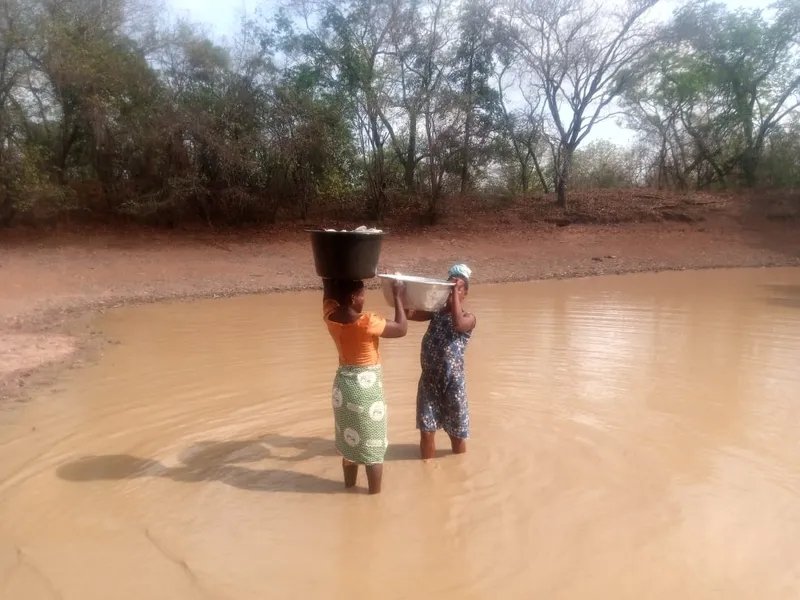
More than 1,000 people in Yankazia, a farming community in Ghana’s Saboba District, are relying on unsafe water sources, including some shared with animals.
Residents in the Northern Region say they must travel long distances to collect water for drinking and household use, raising concerns about the effect on women and children and the risk of waterborne diseases.
Some families use whatever supplies they can find because there is no dependable alternative. Residents are calling for a borehole and a lasting source of potable water to end the daily struggle.
Leticia Jijir, a resident of Yankazia, said the water was affecting children’s health.
“The water we drink is not clean,” she said. “Our children are frequently falling sick.”
She added that families had no other water available to give them.
Njom Susanna said women were carrying much of the burden because they were largely responsible for collecting water for their households.
“As women, we are the ones who suffer most,” she said, describing the long distances women sometimes had to walk before finding a source.
Abraham Mamkrom, the chief’s representative, said some residents travelled more than nine miles in search of water. However, he said the sources they eventually reached were “not safe for drinking”.
He appealed to the government, charities and other stakeholders to support the provision of clean water in Yankazia.
Similar requests have led to projects in other communities. Two boreholes have been completed in Zenu and Gbetsile, while charities recently supplied communities in Sissala West with a solar-powered mechanised borehole.
Andrews Mawie Kusan, the assembly member for the area, said the Member of Parliament for Saboba had made efforts to provide boreholes, but drilling had been affected by difficult underground water conditions.
“Some of the boreholes drilled have not produced the expected results,” he said.
George Wumbei, the Saboba District Chief Executive, declined to comment when approached about the situation.
Residents say support from outside the community is needed to secure a reliable water supply. Their appeal reflects the wider aim of Sustainable Development Goal 6, which seeks to ensure access to safe water for all by 2030.
Other local assemblies have responded to similar demands by developing new sources, including boreholes at Teshie-Nungua.