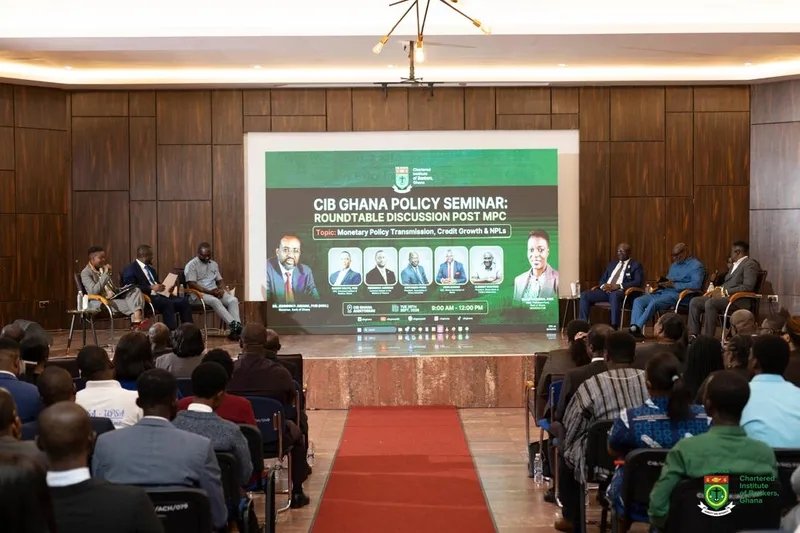
Borrowers at Ghana’s universal banks are benefiting from lower interest rates sooner than customers of community and microfinance banks, a survey presented by the Chartered Institute of Bankers, Ghana (CIB Ghana) has found.
The findings were discussed at CIB Ghana’s third Post-Monetary Policy Committee (Post-MPC) Policy Seminar, held at the CIB Ghana Auditorium and streamed on the Institute’s social media platforms. The event brought together the Bank of Ghana (BoG), the Ministry of Finance, banks, traders and industry representatives to examine monetary policy transmission, credit growth and non-performing loans (NPLs).
It followed the 132nd meeting of the BoG’s Monetary Policy Committee (MPC), which unanimously decided on 24 September 2026 to leave the policy rate unchanged at 14.0 per cent.
Opening the seminar, CIB Ghana Governing Council President Dr Ellen Ohene-Afoakwa said monetary policy affected more than economists and central bankers, with its impact extending through financial markets, lending conditions, businesses and households.
She said the success of monetary policy depended not only on movements in the policy rate, but also on whether those changes were passed through to the wider economy.
“As an institute, we recognise that credit growth and credit quality must move together,” she said.
Dr Ohene-Afoakwa said Ghana needed a banking sector capable of financing productive areas of the economy while maintaining effective risk controls and responsible lending practices. She added that preventing bad loans should receive greater attention than attempting to recover them after they had deteriorated.
In remarks delivered on his behalf by BoG Director of Research Dr Simon Harvey, Governor Dr Johnson P. Asiama said policy-rate changes did not reach borrowers immediately. Banks, he explained, also considered their funding costs, credit risk, operating expenses and expected losses when setting loan prices.
“This transmission is neither automatic nor instantaneous,” the Governor said.
He said monetary policy was intended not merely to reduce interest rates, but also to anchor inflation expectations, support currency stability and preserve the soundness of financial institutions. He again emphasised the importance of preventing NPLs.
Dr Asiama said the MPC considered CIB Ghana’s Pre-MPC survey, submitted before each meeting, to be insightful, helpful and complementary to the central bank’s own analytical models.
CIB Ghana Chief Executive Officer Mr Robert Dzato presented the September Pre-MPC sentiment survey, conducted by the Institute’s research team among banks before each MPC meeting.
The survey indicated strong willingness to lend, although the transmission of monetary policy differed between banking segments. “We see appetite to lend is quite high,” Mr Dzato said.
Most universal banks surveyed reported lending rates of 10 to 15 per cent. In the community-banking sector, 46 per cent reported rates of 21 to 25 per cent, compared with 36 per cent in the July survey. Microfinance banks reported rates of roughly 31 to 40 per cent.
About 65 per cent of respondents expressed high confidence in the macroeconomic environment, while about 80 per cent judged the current policy stance effective in containing inflation. Some 86 per cent expected the MPC to maintain the policy rate, as it did, and 70 per cent expected inflation to increase over the next three months.
Meanwhile, 71 per cent of banks said they were confident of meeting the 10 per cent NPL directive by the end of 2026.
Mr Dzato described that confidence as encouraging, but warned that faster lending growth would need stronger monitoring, recovery efforts and risk mitigation.
“We are driving credit growth for obvious reasons,” he said, while cautioning that loans not repaid on time could create another problem for the sector.