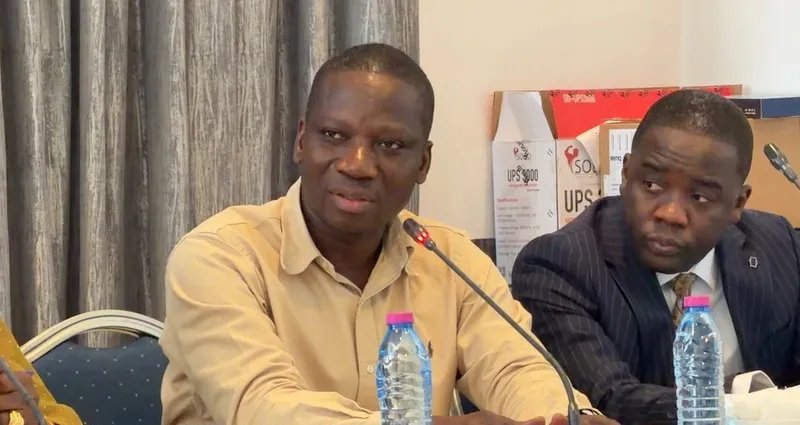
The Prestea Huni Valley Municipal Assembly has been commended by Parliament’s Select Committee on Sanitation and Water Resources for using Internally Generated Funds (IGF) to finance sanitation activities.
Committee chairman Oti Kwabena Bless John, the Nkwanta North MP, praised the Assembly during a public hearing in Takoradi on Friday, October 16. He said using internally generated revenue for sanitation showed a commitment to environmental cleanliness and public health beyond the Assembly’s allocation from the District Assemblies Common Fund (DACF).
“This is the first time we have had a municipal assembly using part of its IGF,” Mr Oti Kwabena Bless John said, referring to the Assembly’s decision to fund its National Sanitation Day activities with internally generated revenue.
He also pointed to government funding provided to Metropolitan, Municipal and District Assemblies (MMDAs) to recruit sanitation workers. The chairman asked the Assembly to provide details of the number of sweepers it had employed and their monthly remuneration.
Committee member and Salaga South MP Ibrahimah Mohammed Zuwera also praised the Assembly’s detailed presentation and its efforts to improve environmental cleanliness. She highlighted the payment of sweepers and the use of IGF to support sanitation work as an example of the Assembly giving back to the community.
“In most areas, they are sweeping only on market days. So we commend you highly for that,” she said.
Equipment and water safety concerns
Despite the praise, the Assembly’s Finance Officer, Thomas Ohene Dwira Asare, told the hearing that several financial and operational challenges were affecting sanitation management and water safety in the municipality.
The Assembly does not have its own bulldozer to clear refuse that has accumulated at some disposal sites, he said, causing delays and creating environmental risks for residents.
“We do not have any bulldozer on our own, and it sometimes delays operations,” Mr Asare explained.
The Assembly has a contract with Waste Land to manage its four final disposal sites, but Mr Asare said other refuse heaps fell outside the arrangement and also needed to be cleared. The lack of suitable equipment made it difficult to respond quickly, he added.
Mining activity has also raised concerns about water contamination. Mr Asare said the Assembly planned to test water quality, including iron levels, before commissioning boreholes.
“Because we are in a mining community, most of our water is contaminated or polluted. So now we want to do water tests and check the iron levels before we even commission boreholes,” he said.
He requested technical support from the relevant sanitation authorities and other state agencies with the expertise to conduct the tests, saying this would help protect residents from health risks linked to unsafe drinking water.
Mr Asare identified delays in releasing the District Assemblies Common Fund as another major constraint. He said disbursements were sometimes below budgeted levels, affecting quarterly payments to service providers and disrupting planned sanitation work. The Assembly consequently had to use IGF to maintain essential services, putting further pressure on its finances.
Its only skip truck for refuse collection is also more than ten years old. Although the Assembly is seeking a replacement, Mr Asare said funding it would force difficult choices.
“If we want to assign the 10 per cent to even buy a skip truck, then it means that other activities are going to be left out,” he said.
He further called for improvements to the Ghana Integrated Financial Management Information System (GIFMIS), saying it lacked a specific code for sanitation expenditure. A dedicated code, he said, would improve financial monitoring, accountability and reporting, while the Assembly might otherwise need separate ledgers.
The committee is expected to consider the concerns raised and make recommendations on sanitation management and water safety in the Prestea Huni Valley Municipality.
By Ebenezer Atiemo