Lionel Messi’s international career with Argentina began with tears, ended with records and trophies, and was shaped by years of criticism, missed opportunities and painful defeats.
The 18-year-old made his senior debut against Hungary in 2005, but was sent off within minutes of coming on after an altercation with Vilmos Vanczak. Messi reportedly left the pitch in tears, an unusually difficult start for the player who would become Argentina’s most celebrated footballer.
He offered a glimpse of his potential at the 2006 World Cup, scoring in Argentina’s 6-0 win over Serbia and Montenegro. But the campaign ended against Germany in the quarter-finals, with the hosts winning on penalties.
Argentina then lost the 2007 Copa America final 3-0 to Brazil. At the 2010 World Cup, Messi’s team were again eliminated by Germany, this time suffering a 4-0 quarter-final defeat under coach Diego Maradona.
The pressure intensified at the 2011 Copa America, when Argentina lost a quarter-final penalty shootout to Uruguay on home soil. Messi’s relationship with sections of the country’s supporters became increasingly strained as his club success with Barcelona was contrasted with his failure to win a major international honour.
He came closest at the 2014 World Cup in Brazil. Argentina reached the final against Germany at the Maracana, but Mario Gotze’s extra-time goal gave the Germans a 1-0 victory. The defeat led to further comparisons with Maradona, who had captained Argentina to World Cup glory in 1986.
There was more heartbreak in 2015, when Chile beat Argentina on penalties after a goalless Copa America final. A year later, Chile won another shootout in the Copa America Centenario final in the United States after Messi’s penalty went over the crossbar. He subsequently announced his international retirement, saying: “It’s over.”
Messi returned, but Argentina went out to France in the last 16 of the 2018 World Cup, losing 4-3 after a memorable display by Kylian Mbappe. Brazil then eliminated them in the 2019 Copa America semi-finals.
The arrival of Lionel Scaloni changed the atmosphere around the national team. With a younger generation developing around Messi, Argentina finally ended their wait for silverware in 2021. Angel Di Maria scored in a 1-0 Copa America final victory over Brazil at the Maracana Stadium, prompting tears of relief from Messi.
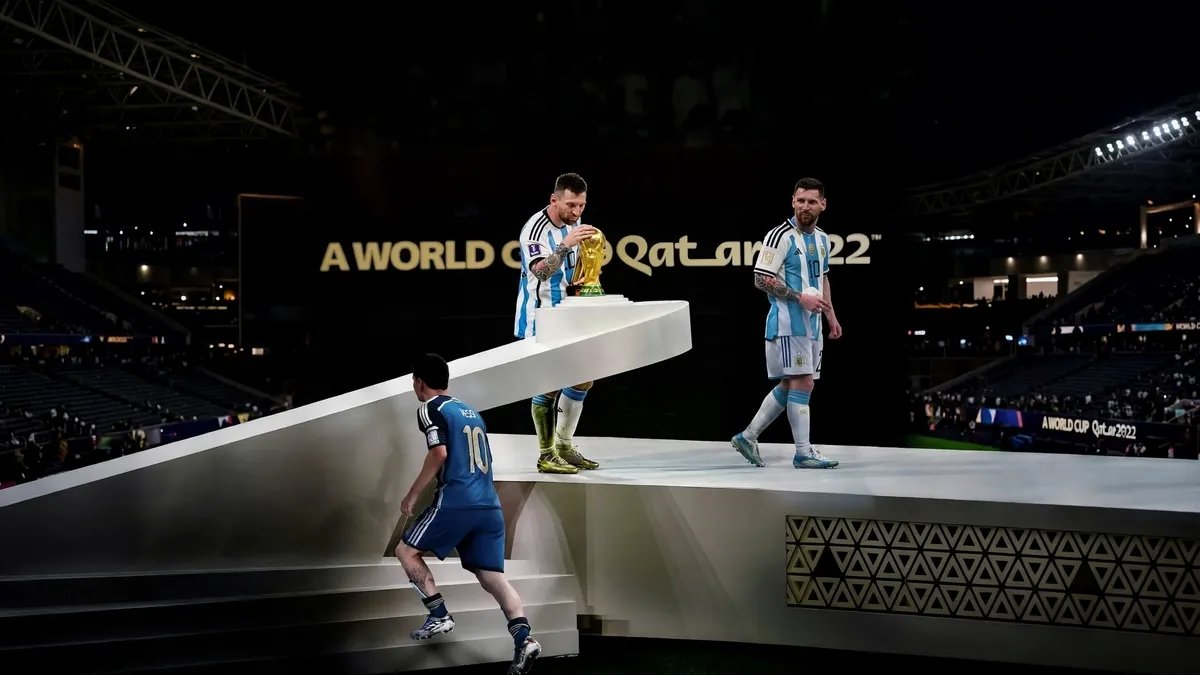
Later that year, Argentina beat Italy at Wembley in the Finalissima. In 2022, despite losing their opening World Cup match to Saudi Arabia, Scaloni’s side recovered and reached the final against France. After a 3-3 draw, Argentina won on penalties and Messi lifted the World Cup at Lusail Stadium.
Argentina retained the Copa America in 2024 by beating Colombia in the final. At the 2026 World Cup, Messi, aged 39, reached his final tournament. Argentina lost 1-0 to Spain after extra time, but he extended his record to 34 World Cup appearances and became the oldest outfield player to play in a World Cup final.
After retiring internationally, Messi was called up for a farewell against Benin at Buenos Aires’ Monumental Stadium on 6 October 2026. His Argentina career, which began with a red card, ended with trophies, records and the acceptance of a nation that had once doubted him.