Ghana has decided to apply for BRICS membership, but the government has yet to establish when it will submit the application, whether it will first seek partner status or what the economic costs and benefits would be.
Foreign Affairs Minister Samuel Okudzeto Ablakwa announced the Cabinet’s decision on 6 October 2026 during a visit by India’s External Affairs Minister, Subrahmanyam Jaishankar. Ghana has already asked India, which holds the BRICS chair in 2026, to assist with the process.
Ablakwa described the move as an attempt to diversify Ghana’s international relationships rather than abandon its traditional partners. Ghana remains a member of the IMF and the World Bank, he said, while citing roughly US$700 million in support from Afreximbank during the 2023–24 crisis as evidence of the importance of non-Western institutions.
Jaishankar said India was sympathetic to Ghana’s ambitions but stressed that membership would require collective consideration by BRICS countries. Ghana and India signed memoranda covering agriculture, and science and technology. Further co-operation was identified in railways, pharmaceuticals, ICT and defence.
The Minority in Parliament, led by the ranking member of the Foreign Affairs Committee, Samuel Abu Jinapor, has called for an urgent briefing.
What BRICS membership would mean
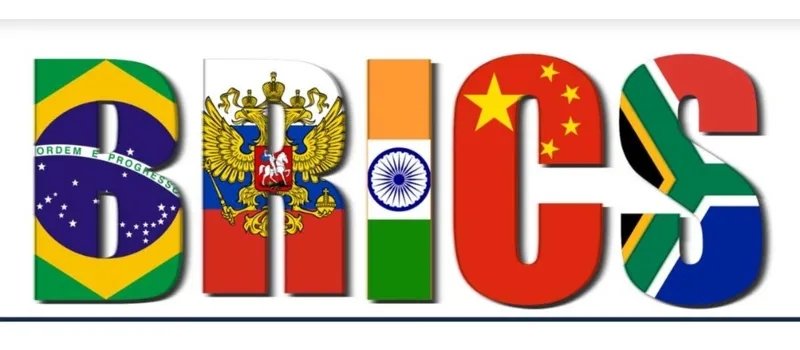
BRICS has 11 listed members: Brazil, Russia, India, China, South Africa, Egypt, Ethiopia, Iran, the UAE and Indonesia. Saudi Arabia has been invited but has not publicly confirmed its membership.
A partner category, introduced in 2024, includes Nigeria and Uganda, as well as Belarus, Bolivia, Cuba, Kazakhstan, Malaysia, Thailand, Uzbekistan and Vietnam. Partners can join selected activities but are excluded from the bloc’s most significant decisions.
Egypt, Ethiopia and South Africa are currently the only full African members. Ghana would be the first full member from West Africa.
BRICS does not have a common currency. At the September 2026 summit in New Delhi, leaders backed further work on payment-system interoperability and local-currency settlement, but did not revive proposals for a BRICS currency. India-Russia trade, often cited as an example of de-dollarisation, reached a high level of national-currency settlement through bilateral arrangements rather than a bloc-wide system.
The group is also divided politically. Foreign ministers failed to agree a joint statement in May amid the war involving Iran. In September, leaders avoided condemning either US-Israeli strikes or Iranian attacks on Gulf states. Iran and the UAE are both members, a significant issue for Ghana because the UAE is its largest export market.
BRICS includes the New Development Bank (NDB), which is headquartered in Shanghai and finances infrastructure and sustainable development. Leaders have asked it to increase local-currency lending. The roughly US$100 billion Contingent Reserve Arrangement provides a liquidity backstop for members facing balance-of-payments difficulties, but is not available to partners. The September summit approved amendments to its treaty and another test run.
Ghana’s economic calculation
Ghana already trades extensively with BRICS economies. The UAE, India, South Africa and China accounted for about 57% of the country’s 2025 export earnings, according to Ghana Statistical Service data. China supplied roughly 22–23% of Ghana’s imports in recent quarters.
The top five export destinations received 71.2% of Ghana’s 2025 exports: the UAE 25.9%, India 16.0%, Switzerland 14.2%, South Africa 10.3% and China 4.9%. Gold bullion represented about two-thirds of export earnings in the fourth quarter of 2025.
Those figures are partly explained by gold-trading routes through Dubai, Indian refineries and South African and Swiss hubs. Membership would therefore formalise existing commercial links more than create entirely new markets. Its possible benefit would be lower transaction costs and greater negotiating influence with countries Ghana already depends on, although deeper reliance on a small group of partners could increase concentration risk.
The NDB is accessible to countries outside BRICS, meaning Ghana could seek its financing without full membership. Cedi-yuan payments are also already being tested: Stanbic Bank Ghana has launched a service for Chinese imports, while GCB is preparing a similar facility.
China introduced zero-tariff treatment for Ghana and other African partners on 1 May 2026. India has become a major buyer of Ghanaian gold since Prime Minister Modi’s July 2025 visit. President Mahama says exports to India increased from about US$3 billion to nearly US$7 billion, although some reports describe US$7 billion as two-way trade, so the figure requires caution.
The government’s wider objective is to process more gold, cocoa and minerals domestically through its 24-Hour Economy and export programmes. It presents BRICS as a potential source of capital, technology and markets to support that strategy.
However, South-South partnerships do not automatically create local value. China’s proposed US$210 million purchase of Atlantic Lithium, which is developing Ghana’s first lithium mine at Ewoyaa, would place the country’s first lithium production in a Chinese supply chain. The extent of local processing will depend on contract terms, local-content rules and Ghana’s bargaining power; BRICS membership itself would not determine those conditions.
Timing and external pressure
The government’s decision follows a period of improved economic stability. The IMF Executive Board completed the sixth and final review of Ghana’s roughly US$3 billion Extended Credit Facility in July 2026 and moved the country to a 36-month Policy Coordination Instrument, which involves monitoring but no new funding.
The IMF says inflation has fallen sharply, reserves nearly doubled by 2025, the primary balance moved into surplus and the risk of debt distress returned to moderate. Fitch upgraded Ghana to B with a positive outlook in May, Moody’s changed its outlook on Caa1 to positive in April, and S&P rates Ghana B-.
Relations with Western partners have become more transactional. USAID has been dismantled, while the United States proposed a US$109 million health compact over five years. Ghana’s Cabinet rejected the offer because of demands involving health data and specimen sharing, with President Mahama describing the conditions as humiliating.
US assistance to Ghana totalled about US$219 million in 2024, including US$96 million for health. US tariffs on Ghanaian goods reached 15% in August 2025 before the Supreme Court ruled in February 2026 that the emergency-powers statute used to impose them did not authorise tariffs.
The most immediate trade concern is the African Growth and Opportunity Act (AGOA), under which Ghana has duty-free access to the US market until 31 December 2026. Renewal has not been decided. Garments and cocoa products are the main beneficiaries, and the trade minister says one garment factory can employ up to 5,000 people.
The EU remains a long-standing market for Ghanaian cocoa, but its deforestation regulation takes effect on 30 December 2026. Together, AGOA and the EU rules highlight how exposed Ghanaian employment and exports remain to Western trade decisions.
BRICS could strengthen Ghana’s argument for negotiating without conditions it considers intrusive, particularly after the health compact dispute. But rejecting US$109 million over five years creates a funding gap, and the government has not explained how health financing will be replaced. The Accra Reset and Mahama’s health-sovereignty agenda remain aspirations rather than funded programmes.
Cheaper Chinese imports may benefit consumers and importers while increasing pressure on local manufacturers. China’s zero-tariff access could help cocoa and other exporters, but Chinese figures show two-way trade of US$14.1 billion with Ghana in 2025, including Ghanaian exports of US$2.67 billion. That indicates an imbalance of roughly US$11 billion.
Ghana’s strongest course may therefore be gradual: pursue partner status, explore NDB membership and expand payment corridors while retaining full BRICS membership as an option. The central question is whether closer ties will diversify Ghana’s economy or deepen its dependence on a narrow set of commodities and trading partners.