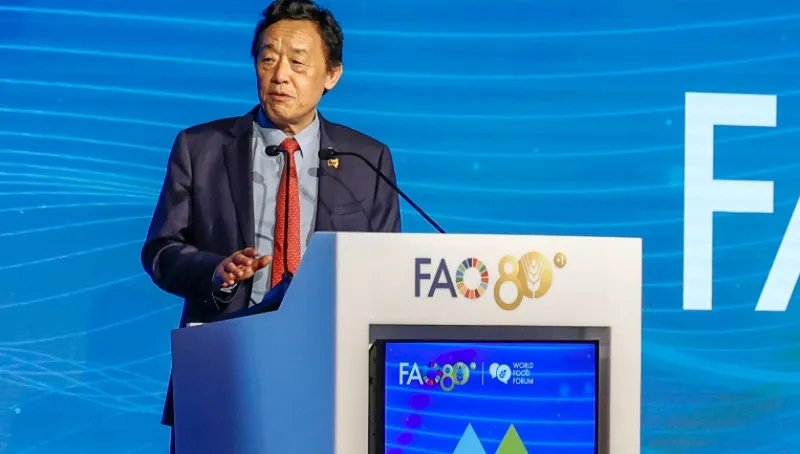
FAO Director-General QU Dongyu has called for more efficient water use, fairer allocation and a move towards circular and regenerative practices to strengthen water and food security.
Speaking at a high-level session of the Rome Water Dialogue 2026, held during the World Food Forum, Qu said recent El Nino events had highlighted the risks facing countries. Rapid changes in rainfall can trigger droughts and floods, causing the loss of human life, livestock and crops.
Such extremes are increasing pressure on limited water supplies and intensifying competition between agriculture, communities, industry and ecosystems.
“Water security is food security. Water is food. Water is life. We cannot achieve one without the other. And we cannot secure water without changing how agriculture uses and manages it,” the Director-General said.
He urged countries to adopt the 4R approach – reduce, reuse, recycle and replenish. The model is intended to help nations produce more and better food with less water, while limiting agriculture’s effect on water resources.
Qu identified four linked priorities: improving efficiency through innovation, dependable data and transparent water accounting; securing fair and reliable access, particularly for small-scale producers, women, Indigenous Peoples and vulnerable communities; preparing more effectively for droughts and floods through early warning systems and proactive risk management; and protecting forests, rivers, lakes, soils and ecosystems that regulate water cycles and support farming.
“These four objectives must be advanced together,” he said. “Efficiency without inclusion deepens inequality. And resilience cannot last without healthy ecosystems or viable livelihoods.”
Through its Framework for Integrated Land and Water Resources Management, FAO supports Members in increasing water productivity and making agrifood systems more resilient.
Water tenure and effective governance
The Dialogue also examined the way water is priced and distributed. FAO said suitable pricing and incentives, backed by effective public policy, could encourage more efficient use while protecting essential needs and vulnerable communities.
“Water has cultural, social, economic and environmental value. Responsible governance must recognize all four,” QU Dongyu said.
FAO launched the Global Dialogue on Water Tenure at the 2022 UN Water Conference. It brings together country-led assessments and consultations with a wide range of stakeholders to develop global guidance based on local conditions.
The organisation will continue helping countries through water tenure assessments, water accounting and National Water Roadmaps. It will also seek to strengthen cooperation between governments, farmers, researchers, civil society, financial institutions and the private sector.
Participants in the high-level session included King Letsie III of Lesotho; LI Junhua, United Nations Under-Secretary-General for Economic and Social Affairs; Yasmine Fouad, Executive Secretary of the United Nations Convention to Combat Desertification; Retno L. P. Marsudi, United Nations Secretary-General’s Special Envoy on Water; and ministers and senior officials from Tajikistan, Turkiye, Kazakhstan, the Syrian Arab Republic, the Kingdom of Saudi Arabia, Thailand, Morocco and China.
Representatives from Germany and Sri Lanka also attended, alongside Winfried Wicklein, Director General, Asian Development Bank (ADB).