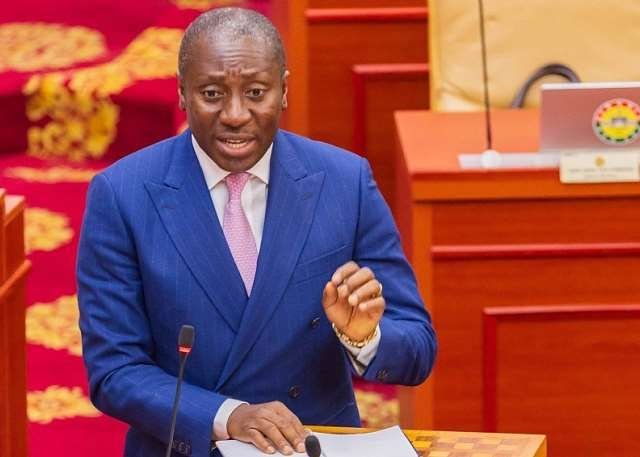
Ghana’s Minority Leader, Alexander Afenyo-Markin, says Parliament must investigate losses of 22 billion cedis at the Ghana Gold Board (GOLDBOD) when lawmakers return, and has urged governing NDC MPs not to use their parliamentary supermajority to block the move.
Afenyo-Markin said the Minority would press ahead with a motion requiring GOLDBOD’s management to explain the losses and account for the way the institution operates.
Speaking at a press conference in Parliament on Tuesday, 18 August, he appealed to members of the Majority to support the motion when the House resumes next week.
“Don’t use your supermajority to stop scrutiny of GoldBod operations. Our motion is ready; we have filed, and when we get back next week, we pray that you, the Majority, will support the motion,” he said.
The Minority Leader said the proposed parliamentary scrutiny would focus on the 22 billion cedis in losses recorded by GOLDBOD. He argued that the scale and structure of the losses raised questions about the division of financial risk between state institutions involved in Ghana’s gold trade.
“If one state institution is responsible for buying, aggregating, assaying, and exporting gold and another state institution supplies the capital and bears virtually all the downside, Parliament is entitled to ask whether the risk allocation is prudent.
“GoldBod is using the Bank of Ghana as an alter ego to evade accountability. Its earnings are clean on the surface but dirty in substance,” he said.
His comments centre on the relationship between GOLDBOD and the Bank of Ghana. While GOLDBOD is responsible for buying, aggregating, assaying and exporting gold, Afenyo-Markin said the central bank provides the capital and carries almost all of the financial downside.
He said that arrangement required Parliament to examine whether government policy had allocated risk appropriately, particularly where one public institution undertakes the commercial operations while another bears the consequences.
Afenyo-Markin also described the losses as evidence of deeper problems in the management of public finances and said they were connected to wider government policy decisions.
He further stated that the GoldBod losses amount to a structural bleeding of the national purse and reflect misaligned government policies.
“The IMF tells us that 17% of the value of every ounce of gold sold by the Bank of Ghana simply disappeared. It vanished through the rate paid to miners and the rate used in the books. This is a structural bleeding of our national purse.”
The Minority is therefore seeking a formal explanation from GOLDBOD’s management when Parliament reconvenes. Afenyo-Markin’s appeal places responsibility on the NDC Majority to allow the motion to proceed, despite its control of the House.
The dispute is expected to return to Parliament next week, when lawmakers will decide whether the proposed scrutiny of GOLDBOD’s operations can move forward.