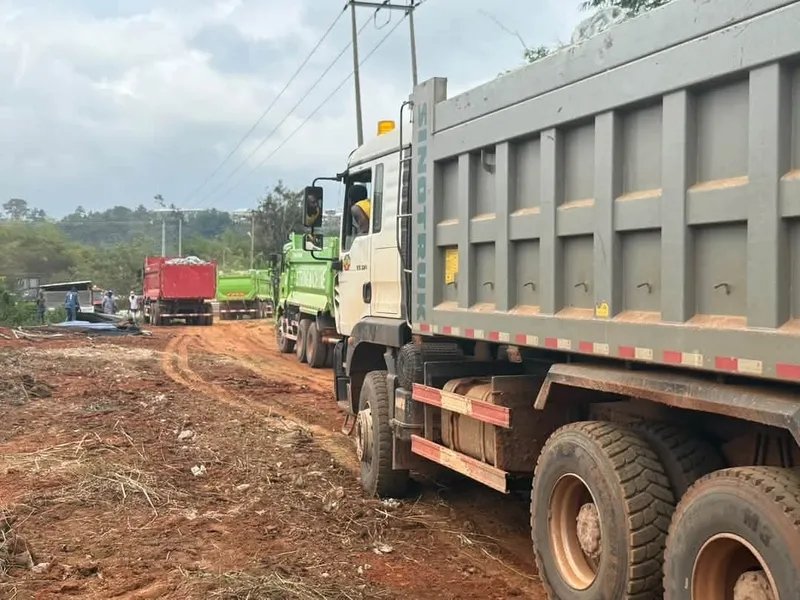
From greenery and tree planting to informal trading and rubbish disposal, road medians are being used for a range of purposes across Ghana’s major cities.
Sections of the Pokuase-Ablekuma Highway in Accra highlight the contrast. Some medians are planted with vegetation, while others have become trading areas or dumping sites.
The differing uses have prompted debate over whether medians are mainly decorative or whether they play a wider role in urban planning, climate management and road safety.
The question is increasingly important as urban growth places pressure on the green spaces available in Accra and other cities.
Benjamin Nsiah, Executive Director of the Centre for Environmental Management and Sustainable Energy, said medians could provide significant environmental benefits when properly maintained.
“Beautification is critical. Aside from beautification, I also think that road median vegetation is able to sequester a lot of carbon, especially from internal combustion engines. I also think that they can even support our national electricity system, because when trees are almost everywhere, your power demand reduces, because it makes sure that your household is always cool, so you conserve energy.”
Civil Engineer Ing. Kwabena Bempong said the spaces were originally designed to serve several practical purposes beyond landscaping.
“The primary engineering reason for the median, for instance, you have a dual carriageway, the median is there to separate those two carriageways. It also provides a refuge for pedestrians who cross the road. The other reason is also that it provides space for utilities and for road furniture. So, you can have maybe the streetlights positioned there.”
He said the value of planting depended on careful design and regular maintenance.
“ The vegetation prevents headlamp glare and reduces the heat stress. Environmentally, we also know it gives a better carbon footprint. It also helps to soak in rainfall.”
However, Mr Bempong warned that overgrown or badly planned medians could create safety problems.
“Road furniture is an important part of the road because it communicates with us. So, if your median is just covered, then there will be no communication, and that could lead to accidents. The other thing is also when they are not well-maintained, sometimes they get into the road space. So that reduces the width of the road.”
Transport and Road Safety expert Dr Godfred Akyea-Darkwah said vegetation should be managed so that it did not block visibility or endanger motorists and pedestrians.
He also criticised the use of medians for farming, waste disposal and trading, saying those activities pointed to failures in enforcement and management.
“It does not affect the safety of road users. It does not affect visibility. Visibility for what? For us to declare medians as not good. They are good. The median is not for a refuse dump and for farming. They should be arrested.”
Dr Akyea-Darkwah added that wider medians could potentially include designated areas for people to rest, but said inappropriate uses should be stopped by district and municipal assemblies.
The challenge, therefore, is not simply planting large trees. Authorities must establish responsibility for maintenance, prevent misuse and choose landscaping that is compatible with the road environment.
With Accra facing increasing urbanisation and climate-related pressures, experts believe better management of existing medians could contribute to a broader urban greening strategy.
By Samuel Yeboah Adams