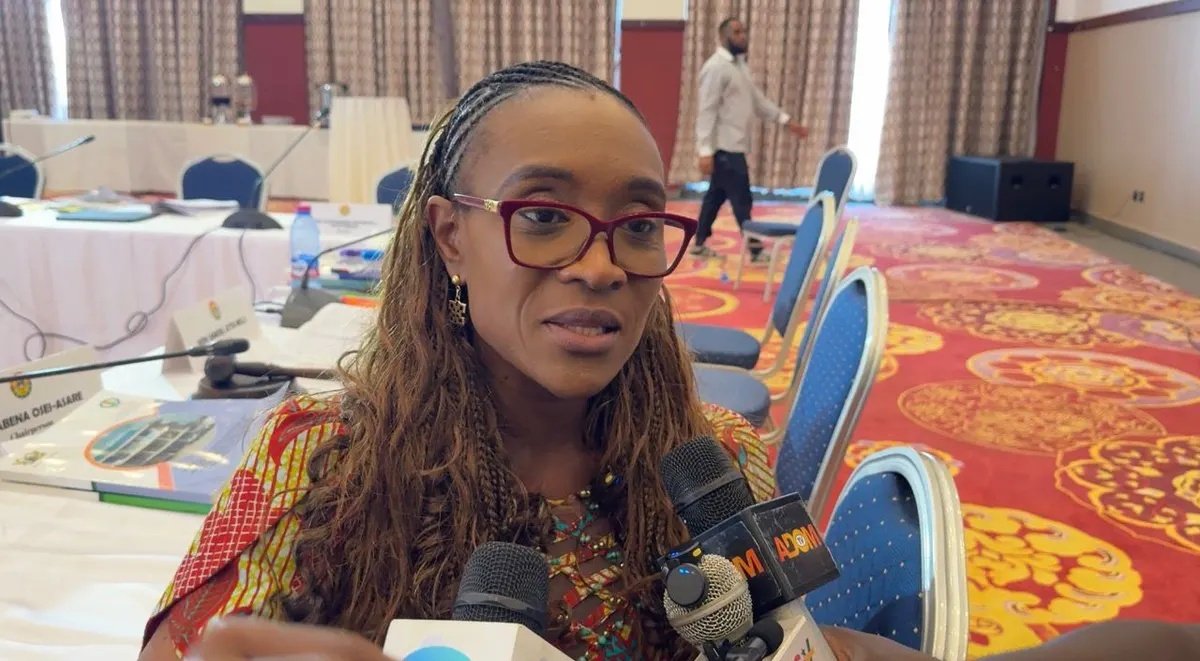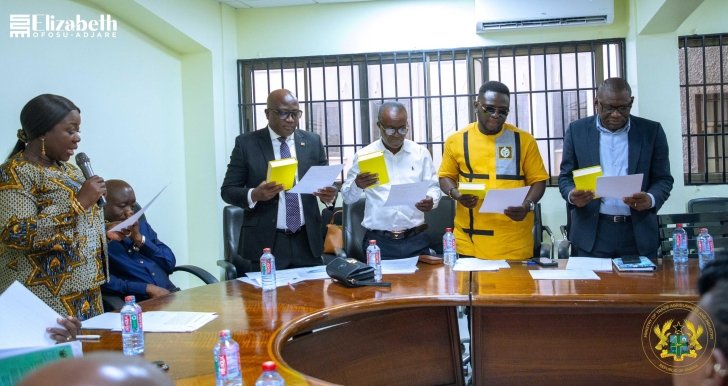
The Minister of Trade, Agribusiness and Industry, Elizabeth Ofosu-Adjare, has inaugurated a committee to lead the operationalisation of the Komenda Sugar Factory.
The factory, constructed more than 10 years ago, has remained dormant for the better part of its life.
The interim management committee (IMC), chaired by Kwame Owusu Sekyere, a lawyer, also has Douglas Mensah, an engineer; John Doku, Lt Col George Afful (retd), and Ransford Vanni Amoah as members.
The six-point Terms of Reference given to the IMC comprise conducting a technical assessment of the factory’s assets, reviewing its financial and business viability, evaluating the sugarcane raw material supply chain, identifying a credible strategic partner, reviewing the ministry’s operational roadmap, and proposing a transition plan towards full operations.
The committee is expected to submit its preliminary findings and recommendations to the ministry within eight weeks.
The inauguration, held in Accra last Monday, marks a renewed national effort to restore the factory to full functionality and economic relevance.
Government officials said it signalled a renewed determination to breathe life into one of Ghana’s key industrial initiatives and transform it into a sustainable source of employment and import substitution.
Inauguration, history
Inaugurating the committee, Mrs Ofosu-Adjare emphasised the significance of the factory as a “prized national asset” initiated under the previous National Democratic Congress (NDC) government.
She said it had been left to deteriorate due to a host of operational and supply chain challenges.
The factory dates back to 2013, when the government at the time contracted Seftech India Pvt to construct a sulphurless sugar plant on a turnkey basis.
Designed to produce 125 tonnes of sugar daily, with plans to expand into ethanol production and power generation, the project initially cost $36.25 million, funded through a loan from India EXIM Bank and a grant from EDAIF, now Ghana EXIM Bank.
Mrs Ofosu-Adjare said in spite of subsequent efforts, including the engagement of Park Agrotech as a strategic investor in 2020 and the involvement of West Africa Agro-Tech Company Limited (WAATCO) under the 1D1F initiative, the factory had not been able to achieve sustainable operations.
“In spite of these interventions, several attempts to operationalise the factory have not been successful,” the minister said.
To break this cycle, she said the government had constituted the high-level IMC to diagnose and address the root issues hindering the factory’s viability.
National significance
Mrs Ofosu-Adjare underscored the broader national significance of the project.
“The Komenda Sugar Factory holds the potential to create enormous jobs in the catchment area, and cutting down on the volume of sugar imports into the country,” she said.
She added that the ministry was committed to supporting the IMC with the resources required to fulfil its mandate effectively.
The chairman of the IMC expressed appreciation to President John Dramani Mahama and the Minister of Trade, Agribusiness and Industry for entrusting the committee with the task of reviewing and reviving the factory.
“We are honoured by the confidence reposed in us and pledge to diligently work on the terms of reference and deliver within the timelines assigned to us,” Mr Owusu Sekyere said.
Background
The Komenda Sugar Factory was originally established in 1964 by Ghana’s first President, Dr Kwame Nkrumah, but later collapsed.
The government secured a $35-million Export-Import (EXIM) Bank, India loan to re-establish the factory.
An additional $24 million facility was set aside to support out-grower farmers.
The factory was commissioned on May 30, 2016, by President John Dramani Mahama to produce sugar, but it became stillborn due to a multiplicity of factors that were described as “technical and operational challenges”.
The factory, which was expected to employ 7,300 people along the value chain in the Komenda-Edina-Eguafo-Abirem municipality, has not been operational since then.
While addressing a durbar of the chiefs and the people of Komenda in the Central Region on September 14, 2018, then President, Nana Addo Dankwa Akufo-Addo, gave an assurance that the government was in the process of getting a strategic investor to revive the factory.
On April 5, 2019, a former Minister of Trade and Industry, Alan Kyerematen, also assured Parliament that a strategic investor would be named by the end of that month to acquire the assets of the factory and help to operationalise it.
Following mounting pressure from the chiefs, youth groups and the people of Komenda for the revival of the factory, the government announced on November 26, 2019, that Park Agrotech Ghana Limited, a Ghanaian-Indian company, had been selected as the strategic investor to revamp the factory.
It was explained that Park Agrotech emerged as the successful bidder after a rigorous selection process conducted by the accounting and advisory firm, PricewaterhouseCoopers (PwC).
The Ghana-based company, a subsidiary of the Skylark Group of Companies of India, one of the largest integrated farming businesses in India, was expected to inject $28 million into the factory between 2020 and 2023.
The company was expected to invest $11 million of the amount into sugarcane cultivation, $6 million to upgrade plant and machinery and $11 million as working capital to bring the ailing factory back on its feet.
The STM Project Limited, a company renowned for sugarcane development and sugar plant modernisation, expansion and rehabilitation for more than 200 sugar factories in India and other parts of the world, was supposed to serve as the technical partner, with technical support from the University of Cape Coast.
However, as of work in March 2020, it emerged that no contract was signed between the government and the company.
Graphic.com.gh