A former member of Tupac Shakur’s entourage has delivered combative testimony at the rapper’s murder trial, saying he was being forced to identify those responsible for Shakur’s death despite not wanting to break a long-standing “street code”.
James “Mob James” McDonald told the court on Tuesday that he had been threatened with contempt of court if he refused to take the stand.
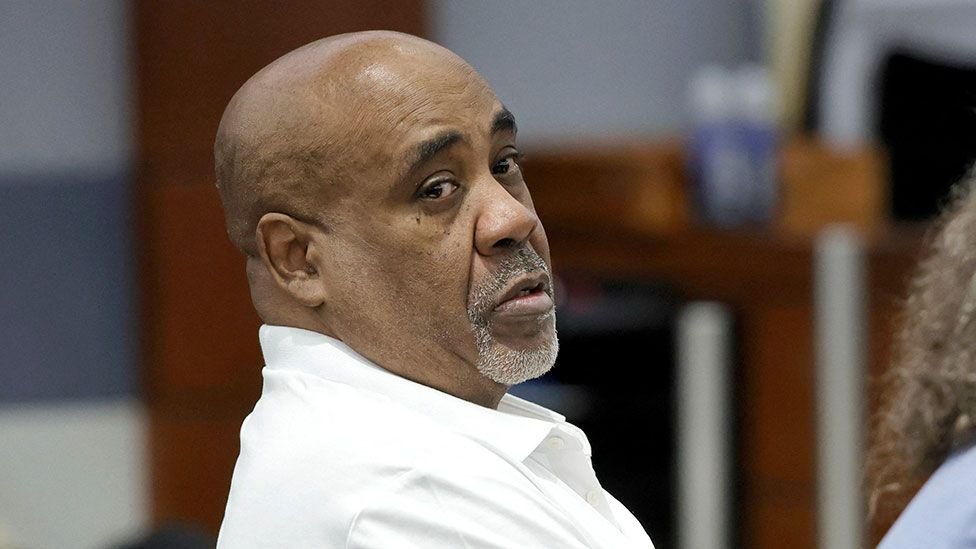
Duane “Keffe D” Davis is accused of orchestrating Shakur’s killing and faces a murder charge. He has denied the allegation and pleaded not guilty.
McDonald was repeatedly asked whether he could identify the people responsible for the shooting. At one point, while gesturing towards Davis, he said: “You’re asking me something that wouldn’t be good for him. I’m not going to send him to prison, you are.”
The trial is intended to resolve one of the most prominent unsolved murder cases in the United States, almost 30 years after Shakur was killed.
The West Coast rapper was 25 when he was shot in a drive-by attack on a Las Vegas street on 7 September 1996. The shooting happened after he attended a Mike Tyson boxing match.
Prosecutors claim Davis, who was formerly a leader of the South Side Compton Crips street gang, helped plan the attack after his nephew, Orlando Anderson, fought with Shakur in Las Vegas earlier that evening.
They allege Davis believed the confrontation could not “go unanswered”.
The killing took place during a period when gangs exerted considerable influence over 1990s hip-hop. A refusal to co-operate with police was part of the prevailing street code, while distrust of authorities was widespread following the Rodney King police brutality case and the riots that followed in Los Angeles.
Shakur, after being wounded and placed in an ambulance, declined to tell a police officer what had happened. Instead, he said: “we’ll take care of it”. He died in hospital six days later.
McDonald’s reluctant testimony
McDonald said he had little affection for Davis but appeared conflicted about giving evidence. He was a former member of Mob Piru, an offshoot of the rival Blood gang, and had worked as an enforcer for Death Row Records, the label representing Shakur.
He stressed that he was not with Shakur when the shooting occurred.
Davis’s defence lawyer, Michael Sanft, questioned McDonald several times about whether he had witnessed the attack and whether he knew who had been present.
McDonald raised his voice and arms under oath, repeatedly saying he did not want to answer questions because doing so “wouldn’t be good” for Davis. At one point, he looked towards the defendant and said: “talk to your lawyer man, this dude is tripping”.
“I don’t want to send him to prison, even though we don’t like each other. I don’t want to send you to prison,” McDonald said, looking at Davis, who sat motionless in a suit.
“You’re asking me questions that can hurt him,” he told Sanft.
McDonald later explained that, although he had not seen the shooting himself, members of Shakur’s entourage who were present had quickly passed on information about who was believed to be responsible.
“It was a gang war. People were getting hurt. People were being sought,” he said. “Orlando (Anderson), him and certain other people were being sought because people wanted to kill them.”
He said there had been calls for revenge against those blamed for Shakur’s death.
“They were the main subjects of a gang war – they were in the middle,” McDonald said of Davis and Anderson, adding that he had also been involved in the conflict.
At the conclusion of his evidence, McDonald turned to Davis and said: “What you are going through brother is what you going through. I don’t want to be a part of it.”
Wright questioned by defence
Reggie Wright Jr, who was part of Shakur’s security detail and later became general manager of Death Row Records in 1997, also gave evidence on Tuesday.
Before the trial, Davis had claimed that evidence instead pointed towards Wright, a former Compton police officer.
Sanft questioned Wright about his work protecting Suge Knight, who was travelling in the same vehicle as Shakur when the shooting took place. The lawyer also asked about Wright’s increasing influence after Knight left Death Row Records.
“And then you became general manager,” Sanft said, pointing out that Wright took control of the record label after Knight was no longer involved. Death Row Records was valued at $3m at the time.
The case is expected to continue on Wednesday.
The investigation had remained largely inactive until Davis made public comments about the killing. He co-authored a memoir in which he said he had been a passenger in the vehicle from which shots were fired at Shakur’s car and that he had supplied the gun used in the murder.
Davis has since distanced himself from the book, saying he did not write all of it and that some sections were fictionalised to help sell copies.