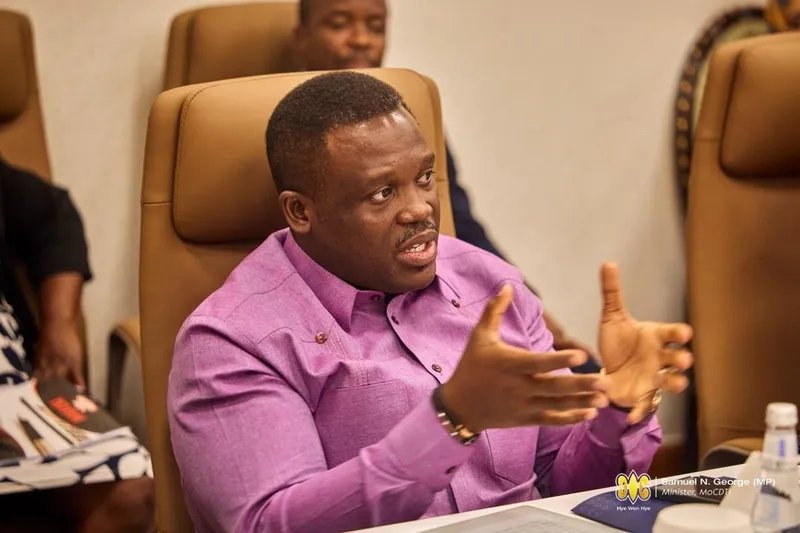
Minister for Communication, Technology and Digital Innovation Samuel Nartey George has called for African countries to work together to shape the continent’s digital future, warning that Africa could be sidelined in global digital governance without a stronger collective voice.
Speaking at the 15th Africa Internet Governance Forum (AfriIGF) in Accra on November 3, Mr George said African nations needed to move beyond producing policies and strategies and focus on delivering practical measures that widened internet access, protected citizens and grew the continent’s digital economy.
Africa has made progress in areas including mobile money, digital innovation and online public services, he said, but millions of people were still excluded from the digital revolution.
The minister identified the cost of internet connections and digital devices as significant obstacles. He stressed that being within reach of a network did not necessarily mean people could afford to use it.
“Progress is not the same as inclusion,” he said, urging a move from access “on paper” to meaningful participation, and from pilot schemes to large-scale implementation.
Call for a stronger African voice
Mr George said Africa could no longer rely wholly on outside solutions to resolve its digital challenges. Instead, he argued, the continent should create technologies, standards and regulations suited to its own needs and circumstances.
Quoting Ghana’s first President, Dr Kwame Nkrumah, he said: “We face neither East nor West; we face forward.”
He added that the message remained relevant as powerful international interests played an increasing role in determining digital rules, standards and artificial intelligence systems.
The minister also called for African countries to adopt a united position in international digital negotiations, saying individual nations would have little influence without continental cooperation.
“Africa cannot be a menu on the table. Africa must have a seat at the table,” he said.
Mr George set out eight areas he said required urgent action. They included affordable internet access, widely available digital devices, infrastructure to support trade within Africa, and the creation of African language models to protect local languages and cultures as artificial intelligence develops.
His other priorities were cross-border efforts to tackle cybercrime, data protection, online safety for children and fair ways for African content creators to earn money from their work.
He placed particular emphasis on safeguarding children online, referring to former South African President Nelson Mandela’s observation that a society’s character is reflected in the way it treats its children.
Africa already has a number of digital development frameworks, including Agenda 2063, the Africa Digital Compact and the Continental Artificial Intelligence Strategy. But Mr George said the immediate problem was not a shortage of policies, but the failure to implement them in a coordinated way.
Ghana’s role
Mr George reaffirmed Ghana’s commitment to advancing Africa’s digital agenda while serving as chair of the African Union Specialized Technical Committee on Communications and ICT for 2026 to 2028.
He said Ghana would take the forum’s conclusions to the African Union so they could help shape decisions across the continent.
Delegates were urged to concentrate on practical solutions, clearly assigned responsibilities and measurable improvements to the lives of Africans.
The 15th Africa Internet Governance Forum brings together stakeholders from Africa and beyond to discuss internet governance, digital inclusion and the future of the continent’s digital economy.