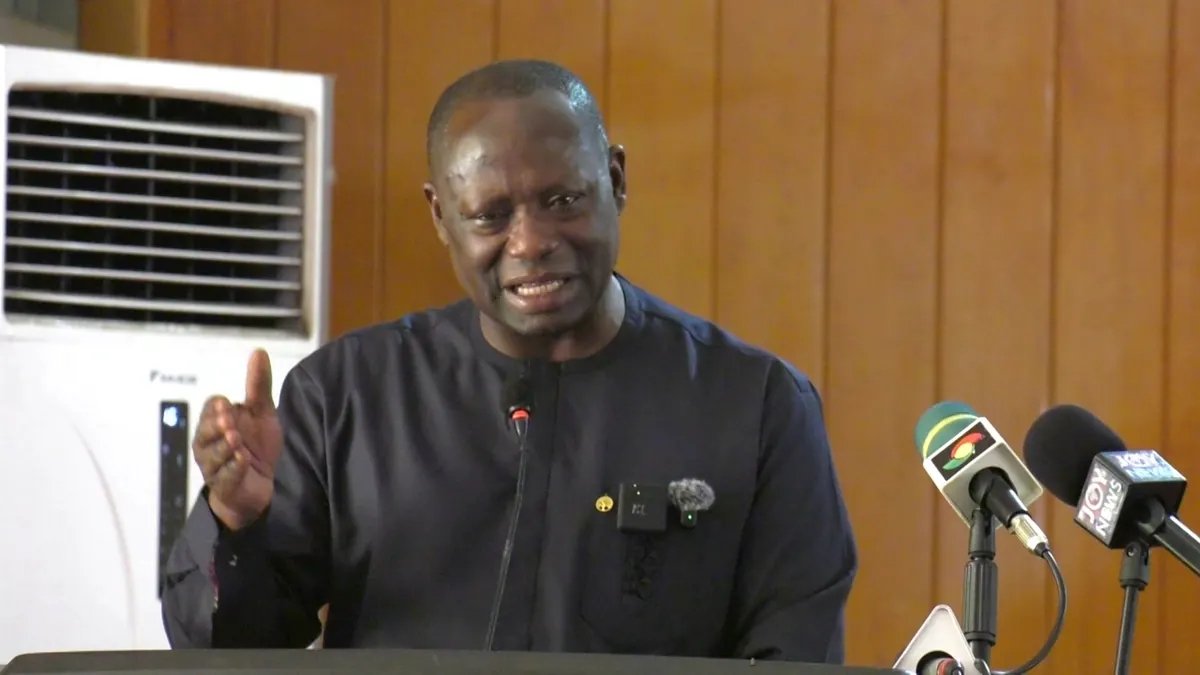
More than 300 filling stations across the country have been incentivised to operate three eight-hour shifts under the government’s 24-hour economy programme, Majority Leader James Agalga has said.
Mr Agalga said the development demonstrated that the policy was already being implemented and producing results, despite criticism from the Minority.
Speaking at a Leaders’ Media Briefing on Monday, November 3, he rejected suggestions that the programme had yet to deliver concrete outcomes.
“24-hour economy is working. But we made it clear that 24-hour economy is not an event. No, it’s a process,” he said.
The Majority Leader was responding to demands from the Minority for specific examples of businesses or sectors where the three-shift system had been introduced.
He identified the petroleum retail sector as evidence of the policy’s implementation, saying more than 300 stations were now operating under the arrangement.
“But if he’s asking us to give him examples of where and how the three-shift system has been implemented, I will tell him that currently we have over 300 filling stations dotted around the country, which has started running the three-shift system,” he stated.
Mr Agalga also said many of the stations had not previously provided services around the clock.
“Yes, you’ll be shocked. I expect you to be shocked. They were not running 24-hour services. Today, yes, they have been incentivized,” he added.
He said the total number of businesses involved would rise significantly once manufacturing companies that had joined the programme were included.
“In fact, manufacturing is inclusive. So, if I add the numbers from the number of manufacturing companies, factories, that have hooked onto the 24-hour policy, the figure I’m mentioning should be in the region of 500. So 24-hour economy is working,” he said.
The 24-hour economy is a flagship policy of the National Democratic Congress (NDC) government. It is intended to stimulate economic growth, create jobs and improve productivity by encouraging businesses and public institutions to operate three shifts of eight hours each.
The government says participating businesses will be supported through incentives including cheaper electricity for off-peak operations, tax waivers and security assistance.
The programme was officially launched earlier this year, with the government identifying manufacturing, agro-processing, transport and retail services as priority sectors for its initial rollout.