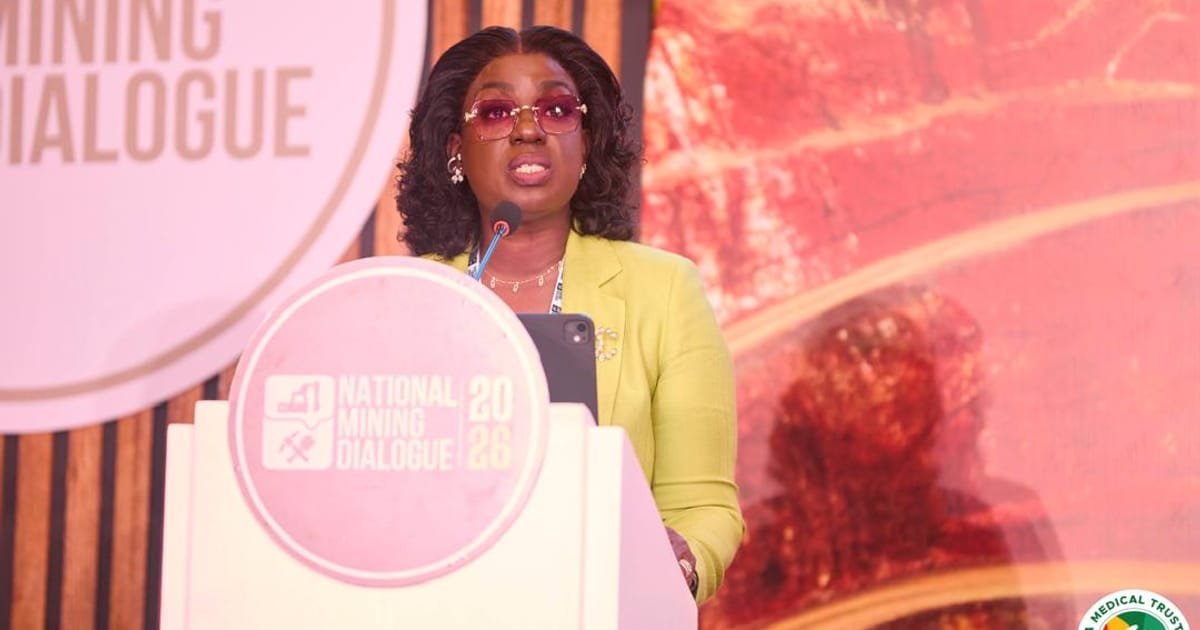
Ghana’s mining companies must invest in healthcare infrastructure and specialist services, rather than focusing only on roads, schools and boreholes, the Administrator of the Ghana Medical Trust Fund (GMTF), Adjoa Obuobia Darko-Opoku, has said.
Speaking at the National Mining Dialogue 2026 in Accra, held under the theme “Rethinking the Social License to Operate”, Ms. Darko-Opoku told mining executives, investors and policymakers that Ghana’s greatest wealth was its people, not the minerals beneath its soil.
“You do not extract value from the soil. You extract value through people.”
She said the failure of the country’s health system would eventually affect every sector, including mining. Wealth, she warned, could not guarantee access to urgent treatment when the necessary facilities and equipment were not available nearby.
Ms. Darko-Opoku asked delegates to consider the consequences of a heart attack occurring in the middle of the night, when there might not be enough time to transfer a patient overseas, even if the family could afford to fly them to London or Johannesburg.
“At 2:00 AM, money cannot buy time. In a medical emergency, your wealth does not save you; the infrastructure nearest to you does.”
She said Ghana’s healthcare difficulties affected rich and poor alike. Families could spend decades building modest lives before a diagnosis such as prostate cancer forced them to use their savings, sell property and borrow heavily to fund treatment.
For people living outside Accra, the burden was often greater because the equipment required to save a patient might not be available in the region. By the time families travelled across the country in search of care, she said, “the family is financially ruined, the patient is significantly weaker, and the cost of treatment has doubled.”
A nationwide needs assessment by the Ghana Medical Trust Fund, covering teaching, regional and referral hospitals, highlighted the scale of the problem.
The assessment found that Ghana’s public tertiary health sector had only two functional MRI machines, five mammogram machines and two public radiotherapy machines for cancer treatment.
The entire northern sector, Ms. Darko-Opoku said, had just two practising cardiologists without the appropriate equipment to serve millions of people. She argued that the impact of those shortages should be understood through the lives affected, rather than statistics alone.
A broader social responsibility
The GMTF Administrator called on mining companies to reconsider what Corporate Social Responsibility should mean in the communities where they operate.
Mining firms have traditionally supported host communities through projects including schools, roads and boreholes. However, Ms. Darko-Opoku said companies now needed to make a greater contribution to the health and longevity of local residents.
“A true Social License cannot simply mean, ‘The community tolerates our presence.’ It must mean, ‘Because this company operates here, our people live longer, healthier lives.”
She said host communities should be viewed as families whose lives could be changed by access to specialised medical care, rather than simply as locations marked on concession maps.
She challenged mining companies to imagine being able to tell residents:
“We didn’t just extract gold from your soil. We built the regional Cancer Centre that saved your mother. We installed the Cath Lab that saved your chief.”
“That is not CSR,” she declared. “That is an unshakable, generational Social License.”
Ms. Darko-Opoku urged mining companies to work with the GMTF to identify healthcare needs in their operating areas, jointly fund essential medical equipment, support the training of specialists and build facilities that could continue serving communities after mining operations had ended.
She said corporate leaders might not ultimately be remembered for the amount of gold they extracted, their quarterly profits or the contracts they signed.
Instead, families could remember the hospital that saved a father, while children might remember the equipment that helped their mother survive cancer. Doctors, she said, would remember the companies that gave them the tools to save lives, and communities would remember businesses that supported them when survival was at stake.
“The gold beneath our soil is valuable. But Ghana’s greatest resource has never been underground. Ghana’s greatest resource is the Ghanaian.”
She called on corporate Ghana, particularly the mining industry, to create a legacy measured not only by the gold taken from the earth, but also by the lives saved above it.
“Let us rethink the Social License. Let us build a legacy of health, dignity and survival. Because when life is on the line, none of us can stand alone.”