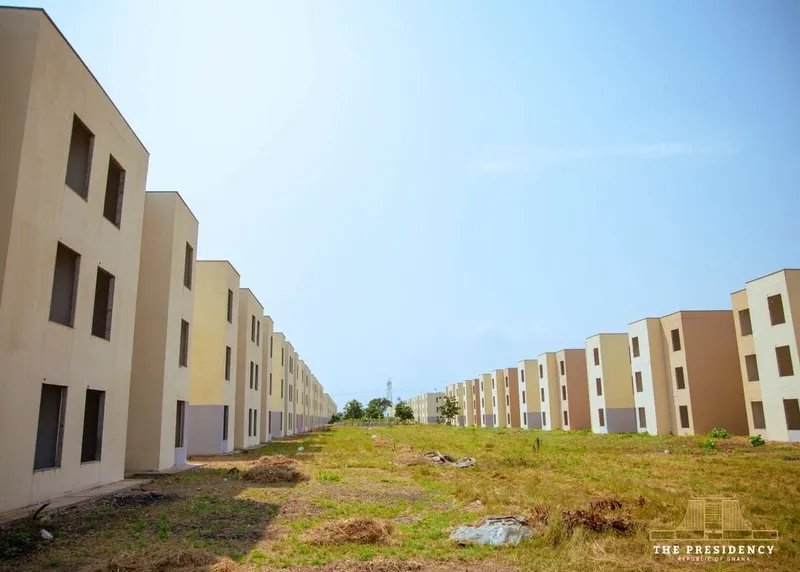
Ghana’s Ministry of Works, Housing and Water Resources (MWHWR) and Ministry of Local Government, Chieftaincy and Religious Affairs (MLGCRA) are marking World Habitat Day 2026 under the theme “Adequate Housing for All”, as the government renews efforts to expand access to safe, affordable and inclusive homes.
The theme highlights housing’s role in providing security, dignity and a foundation for families and communities. However, high land prices, increasing construction and infrastructure costs, and limited access to affordable finance continue to prevent many Ghanaians from securing decent accommodation.
Data from the Ghana Statistical Service shows that about 5% of Ghanaians can obtain housing without assistance. Approximately 60% require state-facilitated support, while 30% percent remain unable to access housing even with government subsidies.
Expanding access to housing finance
The government says it is working with private developers to improve access to land, basic infrastructure and credible off-takers, while using private-sector expertise and investment to increase housing delivery across the country.
Under the National Mortgage Scheme, implemented in partnership with the National Housing Fund and Republic Bank, mortgage finance is expected to be available at an interest rate of approximately 8.4 percent per annum, with repayment periods of up to twenty years.
The scheme is intended to help more Ghanaians, particularly those excluded from traditional mortgage markets, to own decent homes.
The government is also seeking to decentralise housing development beyond major urban centres through programmes including the Greenville District Housing Programme and the National Rental Assistance Scheme.
Measures to ensure that housing benefits vulnerable groups and Persons with Disabilities (PWDs) are also being introduced. Ground-floor units in ongoing developments are reserved for PWDs, while implementing agencies have been instructed to consult disability groups and include accessibility in the planning, design and delivery of housing projects.
Inclusive housing provisions are also being incorporated into the review of the National Housing Policy.
Urban policy and slum upgrading
In July 2026, MLGCRA launched the National Urban Policy and Implementation Plan (2026-2035), alongside the National Slum Upgrading and Prevention Strategy and Implementation Plan (2026-2035).
The frameworks promote inclusive, safe, resilient and sustainable human settlements. They include plans to increase low-income rental housing, expand housing opportunities in slums and informal settlements, simplify approval processes and encourage private-sector and other non-state participation in affordable housing.
The slum-upgrading strategy includes land-tenure regularisation, the provision of public land for low-cost housing, expanded rental opportunities, land pooling and land readjustment schemes, innovative housing finance, and affordable and resilient building technologies.
Government says adequate housing must also be supported by potable water, sanitation, roads, electricity, drainage and public spaces. It will therefore continue working with Metropolitan, Municipal and District Assemblies (MMDAs), financial institutions, development partners and other stakeholders on integrated housing and infrastructure projects.
UN-Habitat has provided technical and financial support for Ghana’s housing and urban-development policies, including Ghana’s Housing Profile 2024 and the two frameworks launched in July. Its work is helping shape reforms, including the review of the National Housing Policy.
The government has called on public institutions, traditional authorities, civil society organisations, development partners, the private sector and citizens to support the goal of adequate housing for all.