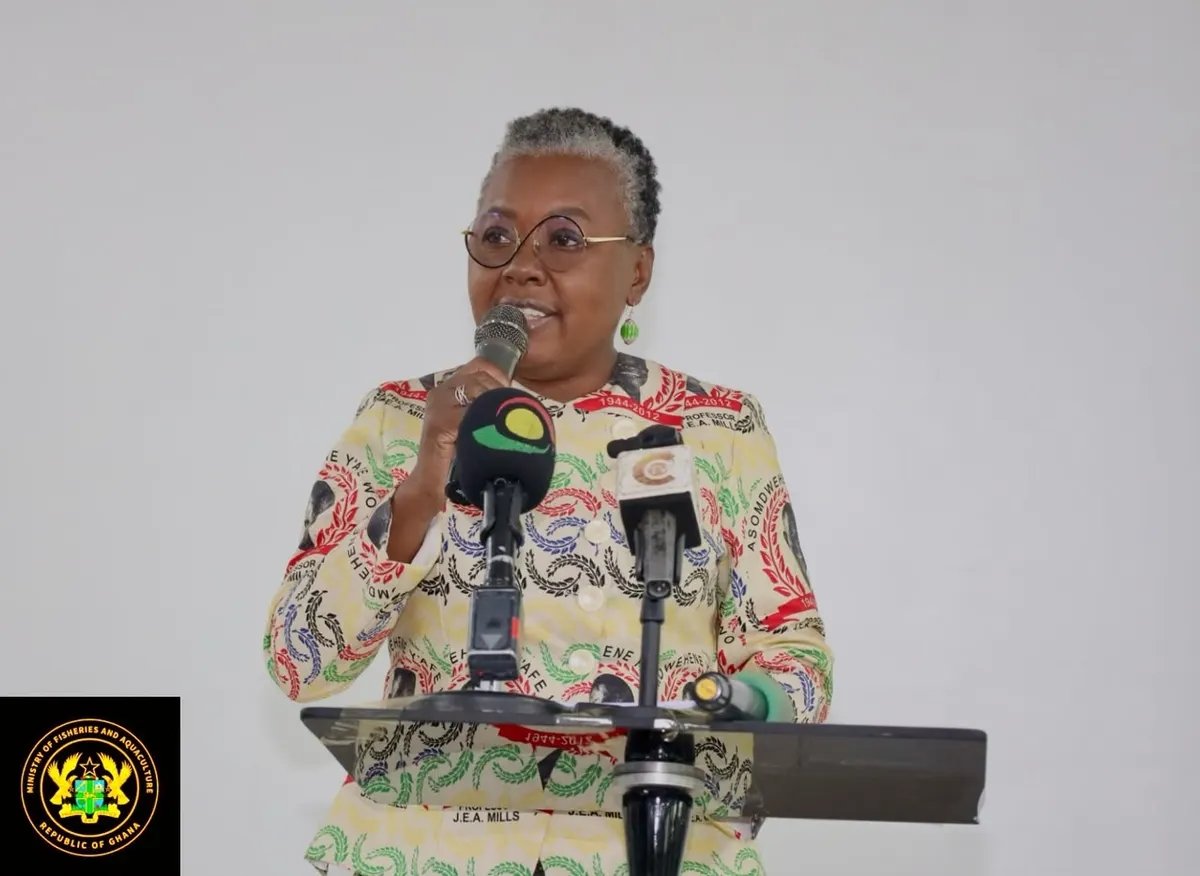
The Minister for Fisheries and Aquaculture, Emelia Arthur, is leading a government drive to strengthen enforcement, increase transparency and attract investment to coastal communities as Ghana tackles illegal fishing and seeks to restore confidence in fisheries management.
The programme includes new legal measures, wider protection for artisanal fishers and a marine conservation strategy, with the government linking the reforms to food security and economic opportunities.
“Fish is far more than a staple on Ghanaian dinner plates; it is the bedrock of national food security and coastal livelihood,” Arthur said at the 37th session of the Food and Agriculture Organization’s Committee on Fisheries in Rome in September.
Her international campaign follows the adoption of the Fisheries and Aquaculture Act, 2025 (Act 1146), and Ghana’s acceptance as a Fisheries Transparency Initiative (FiTI) Implementing Country.
Addressing the Rome meeting, Arthur said the government had introduced tougher maritime enforcement, designated zones for aquaculture and extended the Inshore Exclusion Zone from six to 12 nautical miles. The extension is intended to give artisanal fishing operations greater protection from industrial trawlers.
She also urged international partners to connect scientific expertise with finance, technology and practical opportunities for fishing communities. Ghana’s 10-year Blue Economy Action Plan forms part of that approach.
Transparency status brings reporting duties
Ghana’s progress on fisheries transparency was recognised in August, when the FiTI International Board approved its application for Implementing Country status.
FiTI said the application had been “professional, participatory, and inclusive”, while also noting progress in making fisheries data available through the Ministry’s new Fisheries Information System.
The decision came after an earlier FiTI assessment found that much of the information required for transparent fisheries management was still difficult to access.
However, the designation is a step towards meeting the FiTI Standard rather than confirmation of full compliance. Ghana must publish its first FiTI report by August 2027, covering the 2026 calendar year, and submit further reports annually.
Marine conservation linked to communities
Arthur has also made coastal livelihoods a central part of the government’s conservation policy.
When the Greater Cape Three Points Marine Protected Area was declared in April, she called it “the beginning of a new social contract between people and the sea”.
Vice President Prof Jane Naana Opoku-Agyemang formally declared the protected area during a ceremony in Busua.
Arthur praised government bodies, researchers, fisheries associations, civil society organisations and development partners involved in the process, and singled out Hen Mpoano for its technical contribution and community engagement.
The Ministry says the protected area should help fish stocks recover, repair damaged ecosystems and make coastal communities more resilient. Its success will depend on how the initiative is carried out.
EU yellow card remains a test
Arthur has acknowledged that significant compliance challenges remain. During a September meeting with France’s Ambassador to Ghana, Diarra Dime-Labille, she said Ghana was improving its regulations, monitoring systems and enforcement mechanisms in an effort to secure the removal of the European Union’s yellow card.
She identified the Fisheries Enforcement Unit as central to surveillance and action against illegal fishing.
The government is also seeking French cooperation in research, investment and fisheries security, alongside plans for marine fisheries, inland fisheries and aquaculture to raise production, employment and food security.
The EU yellow card is a formal warning issued under its system for tackling illegal, unreported and unregulated fishing. A red card is more severe and can restrict access to the European market.
Ghana’s next challenge is to turn its new laws and commitments into effective action at sea, public access to reliable information and investment reaching the communities dependent on fisheries.