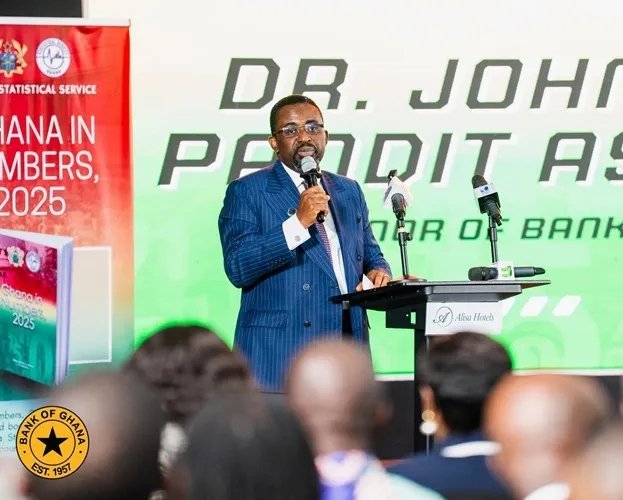
Bank of Ghana Governor Dr Johnson Pandit Asiama has called for the creation of a dedicated electronic portal giving the public access to national statistics in machine-readable formats.
He said the platform would strengthen economic research, policymaking and investment decisions by allowing researchers, policymakers, academics and businesses to use artificial intelligence (AI), machine learning and other analytical tools to examine data more effectively.
Dr Asiama made the proposal on Thursday, October 29, 2026, at the launch of the first edition of Ghana in Numbers 2025 at Alisa Hotel in Accra.
He praised the Ghana Statistical Service (GSS) for compiling the publication, describing it as an important national resource containing authoritative information on Ghana’s socio-economic conditions.
The governor said reliable and timely statistics were vital for monetary policy, financial-sector regulation and wider economic management.
As an inflation-targeting central bank, the Bank of Ghana needs accurate information to assess inflation and the links between prices, exchange rates, economic activity, credit conditions and external developments, he said.
Dr Asiama also welcomed the publication’s dedicated monetary and financial-sector section, which draws substantially on official Bank of Ghana data. He said it offered a clearer view of the country’s economic and financial environment.
Making underlying information more accessible would also help users identify trends and relationships that might not be immediately visible in published reports, he added.
The governor said high-quality statistics support transparency, accountability and public confidence in institutions. They also help businesses and investors evaluate economic conditions and make informed decisions.
He disclosed that the Bank of Ghana was building its capacity in data analytics and emerging technologies through the creation of a Data Analytics and Artificial Intelligence Department.
The department forms part of wider efforts to improve data governance, expand analytical expertise and ensure emerging technologies are used responsibly in policy analysis and institutional decision-making.
Dr Asiama said the central bank was also developing a directive to govern the use of artificial intelligence in the financial sector. The measure is intended to support innovation while addressing new risks.
He said technological progress could improve economic forecasting, reveal patterns and strengthen the evaluation of financial and economic risks.
On the wider economy, Dr Asiama said recent policies and reforms had helped improve inflation, exchange-rate stability, banking-sector resilience and credit conditions.
Inflation had stayed in single digits for 13 consecutive months, while the exchange rate had remained relatively stable despite external headwinds, he said.
The average lending rate fell from 30.25 per cent in December 2024 to 15.78 per cent in September 2026. Over the same period, real private-sector credit growth rose from 0.20 per cent to 26.42 per cent.
The Bank of Ghana was also pursuing measures to widen financial inclusion, particularly among young people, women, micro, small and medium-sized enterprises, and underserved communities.
Dr Asiama congratulated the GSS, its Governing Board, Management and contributing institutions for producing the publication.
He urged stakeholders to use Ghana in Numbers 2025 to assess national progress, improve transparency and support evidence-based decisions.
“Let us see Ghana in Numbers not merely as a statistical publication, but as a national resource for understanding our circumstances, evaluating our progress and making better decisions about our collective future,” he said.