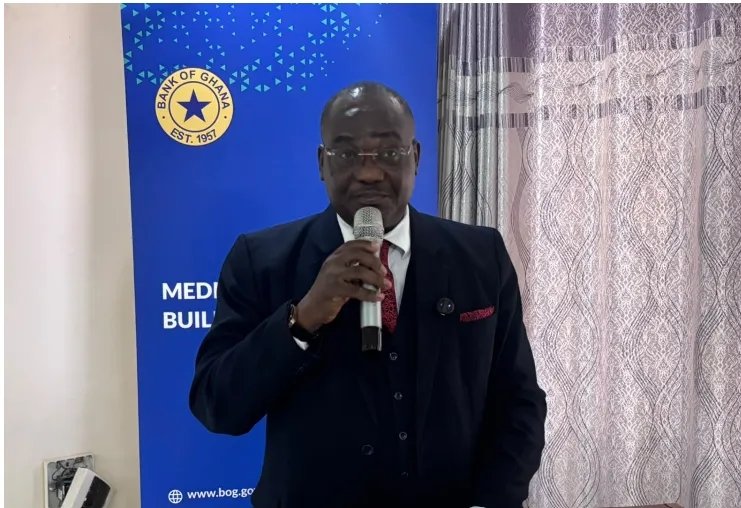
The Bank of Ghana’s Director of Communications, Bernard Otabil, has urged members of the Bank of Ghana Press Corps to explain monetary policy in ways that show how technical decisions affect the daily lives of ordinary Ghanaians.
Mr Otabil made the call on Monday, 19 October 2026, while delivering the welcome address at the opening of a three-day training workshop for members of the press corps.
The workshop, which runs from 19 to 21 October 2026, forms part of the Bank’s continuing efforts to support a well-informed media. Its programme includes sessions on the ethics and accuracy of media reporting, the mandate and regulatory role of the Bank, and the central bank’s balance sheet.
Participants will also examine the Bank’s Domestic Gold Purchase Programme, developments in the foreign exchange market, inflation dynamics, and the interpretation of Monetary Policy Committee (MPC) statements and submissions by members.
Welcoming attendees on behalf of the Governor, Management and Staff of the Bank, Mr Otabil said monetary policy could only achieve its full impact if the public understood and trusted the way it was communicated.
“We believe monetary policy is most effective when it is understood, trusted and accurately communicated,” he said.
He acknowledged that many people might not read MPC reports, but said they often relied on headlines and news reports when making financial and economic decisions.
“Accuracy therefore is not just a professional virtue, it is an economic asset,” Mr Otabil stressed.
The communications director warned that language used in financial reporting could have immediate consequences. He said inaccurate or misleading headlines about inflation, exchange rates or the policy rate could cause panic, encourage speculation and place additional pressure on households and businesses.
He described ethical journalism based on verification, balance, context and clarity as the first line of defence against both misinformation and disinformation.
“Misinformation and disinformation are no longer peripheral concerns. The World Economic Forum’s Global Risks Report now ranks them among the most severe global threats. From deepfakes to AI-generated market rumours, from social media amplification to coordinated disinformation campaigns targeting currencies, no central bank and no country is immune. This is a global phenomenon,” Mr Otabil added.
He said credibility was the most important asset journalists possessed. By maintaining professional and ethical standards, he argued, journalists could help anchor public expectations, protect savings, support economic stability and enable Ghanaians to make informed decisions.
Mr Otabil also reaffirmed the Bank’s intention to strengthen its relationship with the media. Measures include expanded training programmes, the Regional Press Corps, an Editors’ Forum, dedicated WhatsApp communication platforms, and the Governor’s Economic and Financial Story of the Year Award.
He encouraged participants to engage actively with the workshop, ask questions and challenge the Bank’s views where necessary.
Mr Suleiman Mustapha, National Organising Secretary of the Ghana Journalists Association (GJA) and a member of the BoG Press Corps, also attended the opening and delivered brief remarks.