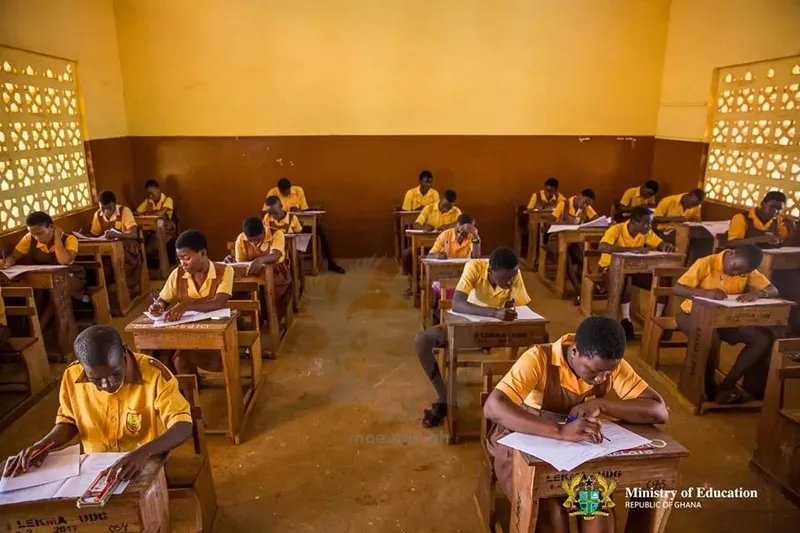
Private schools in Ghana have backed a two-year ban on pupils who sit the Basic Education Certificate Examination (BECE) or the West African Senior School Certificate Examination (WASSCE) before the approved year, but say adults involved in arranging early entries must also face punishment.
The Ghana Education Service has instructed regional directors to enforce the ban. Education Minister Haruna Iddrisu announced the policy on Monday while opening this year’s National Education Week.
Ketu North MP Edem Agbana has also accused schools of falsifying continuous assessment records for pupils who bypass Junior High School 3.
The Ghana National Council of Private Schools (GNACOPS) supported the directive in a statement issued in the name of Obenfo Nana Kwasi Gyetuah.
“Discipline and fairness are not competing demands. They are inseparable duties,” the statement said.
GNACOPS said pupils who are academically advanced should still complete the full curriculum. It argued that schools could provide additional support for exceptional pupils without allowing them to enter the BECE early.
The council said the school-based BECE is a third-year examination, with 30% of the mark based on continuous assessment and 70% on the external paper. Entering a pupil before the approved year, it said, therefore raises questions about the validity of the assessment records.
It added that fabricated records represented an examination-integrity issue, although genuine administrative mistakes should be corrected before any sanctions are imposed.
“Children must be protected from decisions made for them by adults,” the statement said. It added that officials and intermediaries involved in organised misconduct should also be held accountable, in addition to the existing sanctions against staff who help candidates cheat.
Schools should share responsibility
Alhassan Abdul-Fatawu, the MP for Yendi, said on Tuesday that responsibility should fall on the school that presents a pupil for an early examination.
“We can blacklist institutions that present such candidates, rather than the student,” he said.
He said the owners of private schools, heads of public schools and Ghana Education Service directors should be assessed on whether pupils are entered for examinations at the correct time.
Raphael Kofi Gapson, general secretary of the National Council of Parent-Teacher Associations, said on Monday that the policy was appropriate, but believed there should be an exception for genuinely gifted pupils who had a clear and legitimate reason to progress more quickly.
However, he said the restriction should remain when a parent or school pushes a child into an examination for which they are not ready.
Dr Bernard Tutu-Boahene of the University of Education, Winneba, said on Tuesday that children develop at different rates.
“Remember that IQs differ. Remember that maturity rates differ,” the lecturer said.
He questioned why a pupil capable of taking the examination in JHS One or Two should be made to wait three years, particularly when some pupils complete the course and still fail.
Link to senior high placement
GNACOPS said pressure surrounding senior high school placement was partly driving early entries. It cited reports that the proportion of Category A places reserved for public basic school pupils ranged from 30% to 15% in 2025.
The council called for a single published rule setting out the legal basis of the quota, the pupils who qualify and the duration of the arrangement.
Placement already matches a candidate’s aggregate with their selected schools, but GNACOPS said the reserved share should be stated with the same clarity.