National Democratic Congress (NDC) National Chairman Johnson Asiedu-Nketiah has warned that foreign interests must not use money, information systems, diplomatic influence or selective election assessments to shape another country’s political choices.
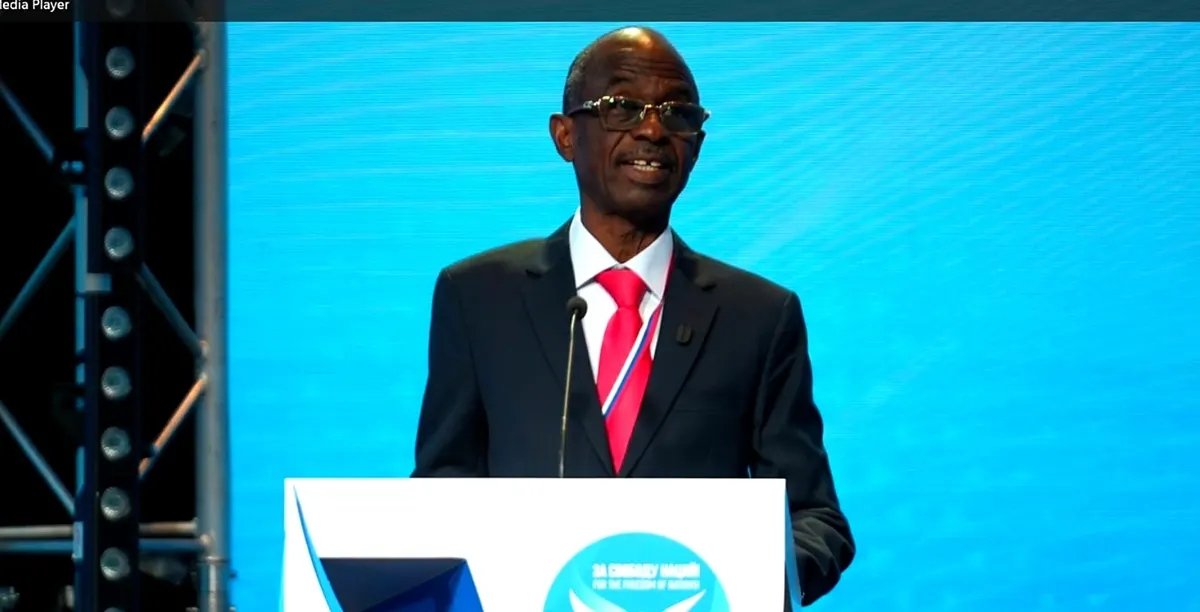
Speaking in Moscow at an address titled Electoral Neocolonialism: Political Sovereignty and Impartial Assessment of Elections, Mr Asiedu-Nketiah said foreign interference posed a serious risk, but cautioned that “not every unfavourable observation” should automatically be treated as interference.
He was speaking as Chairman of the Bureau Leadership of the African Political Parties Initiative (APPI) and as a Member of the Standing Committee of the Movement for Freedom of Nations.
The ‘pink sheet’ test
Mr Asiedu-Nketiah used Ghana’s polling-station “pink sheet” as the central example in his argument. The document records the results after voting and is checked and signed by party agents, who retain copies.
“There is a piece of paper familiar to every serious political party organiser in Ghana. We call it the pink sheet,” he said. “Long after the speeches, advertisements and rallies are forgotten, that document is supposed to tell us what the people decided.”
Drawing on his experience as a witness during Ghana’s 2020 presidential election petition before the Supreme Court, he said political dissatisfaction had to be separated from claims that could be proved with evidence.
“Our courts require evidence. Voters are entitled to the same discipline from all of us who claim to speak for them,” he said.
He argued that electoral sovereignty belonged to voters rather than the government of the day or the party able to attract the largest crowds.
“If a farmer leaves the field to vote, or a trader closes her stall to queue at the polling station, that sacrifice must be honoured with a count that can be verified,” he said.
Mr Asiedu-Nketiah cited Ghana’s 2012 and 2020 election petitions, as well as the change of government through the ballot in December 2024, as examples of why political competition, election administration and judicial remedies must withstand closely contested elections.
“A credible result is not one that nobody questions. It is one that can withstand questions asked through lawful procedures,” he added.
Scrutiny of observers and digital influence
He said risks were particularly acute between the polling station and the national declaration, when a signed result held by a party agent might differ from a figure produced during collation. He called for original documents to be preserved, calculations to be reconciled openly, corrections to be recorded and effective avenues for challenge to be provided.
“ The refusal to explain a discrepancy can damage confidence more quickly than the original mistake,” he said.
Mr Asiedu-Nketiah said election observers should be judged by their methods rather than their nationality or prestige. They should examine the legal framework, monitor campaigning and public-resource use, follow collation, and make clear which stages remain incomplete when issuing preliminary statements.
He referred to the African Union mission to Ghana in December 2024, which praised aspects of voting and counting while highlighting weaknesses in campaign-finance rules and possible misuse of state resources.
He also warned of anonymous digital advertising, disguised political funding and fabricated recordings that could cross borders within minutes. However, he said efforts to combat interference must not become a justification for censorship.
“A government that shuts down legitimate criticism in the name of fighting interference has already injured the sovereignty it claims to protect,” he said.
He called on the Movement and regional bodies including the African Union to develop common standards covering political-finance disclosure, trained domestic observers, transparent collation, prompt publication of polling-station results and timely election-dispute procedures.
“What we do not need is an international arrangement in which friendly governments certify one another’s elections as fair before the evidence is examined,” he said.