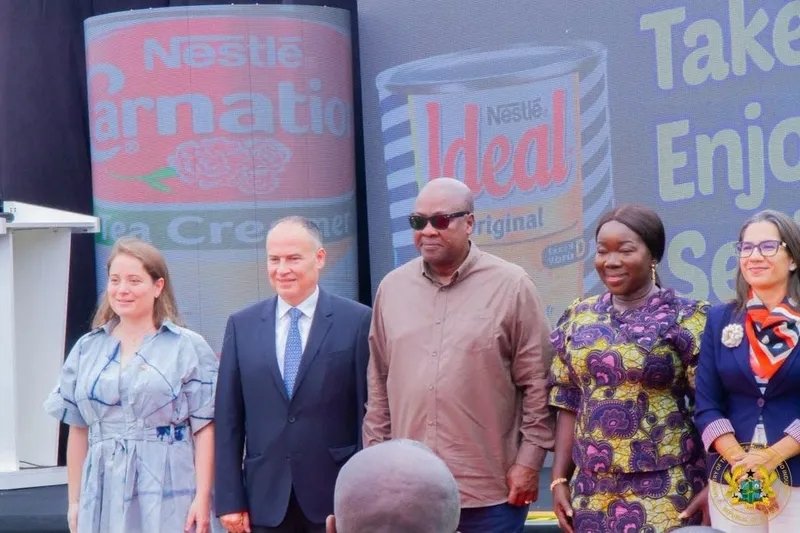
Nestle Ghana has increased the annual evaporated milk production capacity of its Tema factory to 30,000 tonnes, with President Mahama commissioning the expanded facility on Thursday, October 8, 2026.
The new line can produce up to 500,000 cans a day and is expected to nearly double the factory’s previous capacity for evaporated milk. The expansion forms part of Nestle Ghana’s continued investment in local manufacturing and the country’s industrial development.
Nestle Ghana Managing Director Salome Azevedo said the project demonstrated the company’s confidence in Ghana and its long-term commitment to producing locally.
“This milestone reflects our commitment to local manufacturing and our confidence in Ghana’s very bright future,” she said.
Azevedo said Nestle’s operations in Ghana began in 1957, the year the country gained independence. When the Tema factory was commissioned in 1971, Ideal Milk was among the first products made there.
The factory now produces more than 75,000 tonnes of products each year. Its output includes Milo, Cerelac, Ideal Milk, Carnation and Nescafe.
President Mahama described the investment as an important example of Ghana’s ability to manufacture more of the products it consumes, while also building the strength of its domestic manufacturing sector.
He said the expansion supported the government’s 24-hour economy initiative, which is intended to encourage continuous production, increase industrial activity and create jobs.
The Tema factory operates 24 hours a day, seven days a week, according to Azevedo. She added that Nestle Ghana had continued to invest in sustainable production as it expanded its manufacturing operations.
She credited the new line to the teams involved in designing, installing and testing the facility, as well as the operators responsible for running it.
Azevedo said the investment would deepen Nestle Ghana’s contribution to local manufacturing and generate shared value for consumers, employees, families and communities.
“This investment builds on a legacy of shared progress, strengthens local value creation, creates opportunities across our value chain and reinforces Ghana’s position as a competitive manufacturing destination,” she said.