A 68-second film reel showing Ghana’s first President, Dr Kwame Nkrumah, pouring libation at the Akosombo Dam site has renewed interest in footage from his time in office.
The silent 16mm recording, dated to 1963, was posted on X on Thursday by the history account Ghanaian Museum. It shows Nkrumah carrying out the traditional ceremony before touring excavation works in the Volta gorge alongside project officials.
The footage has attracted attention amid continuing interest in images from Nkrumah’s presidency. The Bank of Ghana retained his portrait on the new Heritage Series cedi notes announced on 12 November.
The opening 16 seconds have been colourised. Nkrumah is shown standing on rocky ground in a dark, collarless tunic, with a white shirt underneath and a white handkerchief in his left hand.
Holding a small glass, he pours libation on to the ground twice while Ghanaian officials and expatriate engineers wearing hard hats watch. He then crosses the excavated rock bed with the aid of a walking stick, smiling and talking to site engineers as graded hillsides can be seen behind them.
At 17 seconds, the film changes to a black-and-white 16mm transfer, complete with visible borders around the frames. Ghanaian labourers are shown operating a rotating concrete mixer, while women carry headpans filled with wet concrete past stacks of blocks and timber scaffolding.
On Tuesday, President John Dramani Mahama honoured Nkrumah’s personal cameraman, Rev Dr Chris Hesse, for documenting and preserving film reels from Ghana’s first republic.
The final moments show Nkrumah waving to workers gathered beside parked vehicles. He gets into the rear seat of a dark saloon car bearing the number plate SG 5803 and leaves while a cameraman in a bush hat records the departure.
Building the Volta River Project
Parliament established Ghana’s state power utility on 26 April 1961 under Act 46, the Volta River Development Act, according to the Volta River Authority profile.
Australian geologist Sir Albert Kitson first identified the Akosombo gorge, then known as Nkonson-konson-bo, as a possible hydroelectric dam site in 1915. Construction began in 1961, 46 years after his survey, as the project became central to Nkrumah’s post-independence industrialisation programme.
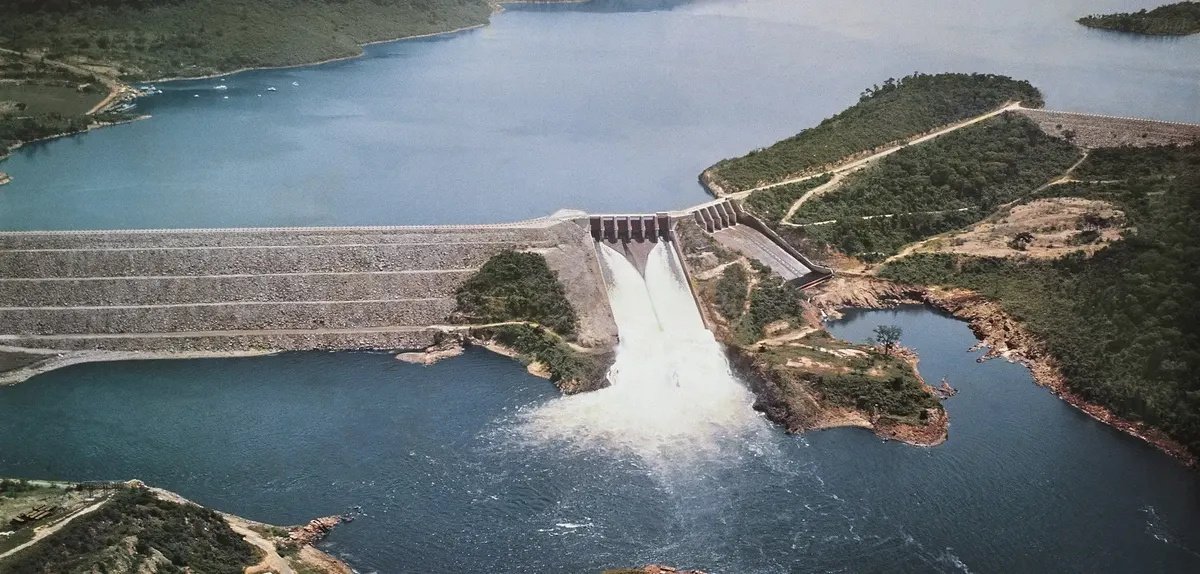
The Volta River Authority says the main gravity rock-fill embankment dam is 2,200 feet long along its crest, 1,200 feet wide at the river bed and 374 feet high from bedrock. A second rock-fill embankment, known as the saddle dam, was built half a mile away to close an adjacent valley.
British Pathe and Reuters are among the international film archives holding footage of the project, including Queen Elizabeth II’s visit to the gorge in November 1961 and Nkrumah’s launch of the works on 23 January 1962.
The project impounded the White, Black and Red Volta rivers, together with the Oti River, creating Lake Volta across 8,502 square kilometres, or 3,275 square miles. The reservoir extends 400 kilometres inland and reached its full level in 1968. The Volta River Authority later established a Resettlement Trust Fund covering 52 resettlement townships.
On Thursday, Bank of Ghana Governor Dr Johnson Asiamah met the families of national figures featured on the Heritage Series notes ahead of the currency transition.
Nkrumah formally inaugurated the completed Akosombo hydro scheme on 22 January 1966, one month before his government was overthrown.
The station was originally built with six generating units rated at 912 megawatts on the west bank. It was later upgraded to generate 1,020 megawatts, according to the Akosombo Hydro Electric Power Plant specification. Together with the 160-megawatt Kpong plant downstream, it remains the backbone of the Volta River Authority’s hydroelectric generation.