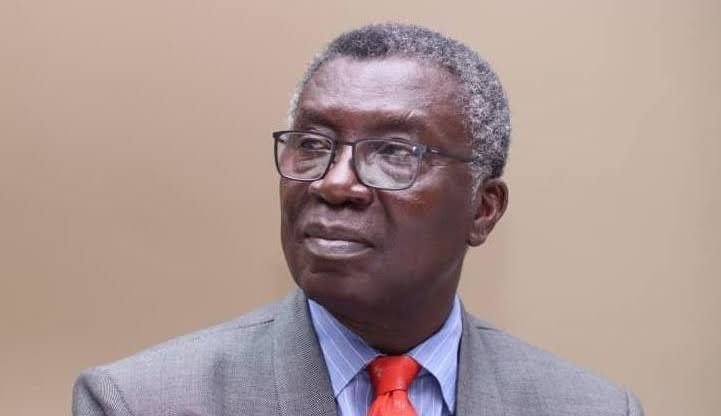
Professor Kwabena Frimpong-Boateng says Ghana developed much of the technology needed to tackle illegal mining, but weak institutional commitment meant the system was not properly used or enforced.
He chaired the Inter-Ministerial Committee on Illegal Mining from March 2017 until January 2021. He says the rivers the committee was appointed to protect are now in a worse condition than when he took office.
That, he argues, must be the starting point for any serious assessment of the country’s efforts to combat galamsey.
Responding to an essay by Richard Dablah, Prof Frimpong-Boateng agrees that the young man working in a mining pit is often the most expendable part of a much larger operation.
Before gold reaches the miner, he says, others have financed the work, supplied machinery, secured access to land, organised processing, moved the money and, in many cases, provided protection.
Illegal mining is therefore a network rather than a single activity, he says, and repeatedly arresting those at the bottom of that network will not dismantle it.
He also agrees that galamsey shifts value from the future into the present. Miners receive immediate income, financiers take their returns and traders secure their margins, while society is left with polluted water, destroyed farmland, lost forests and public-health costs.
Prof Frimpong-Boateng says those costs are no longer merely a future threat. Ghana had approximately 8.8 million hectares of primary forest at the beginning of the last century, falling to 4.2 million hectares by 1950 and about 1.5 million by 1999.
“We are paying now,” he writes.
The system Ghana developed
Prof Frimpong-Boateng disputes one central assumption in Mr Dablah’s argument: that Ghana has never attempted a sophisticated national response to illegal mining.
Mr Dablah called for an “ecological intelligence system” involving satellite imagery, drones, geographical links between mining licences and forests or rivers, equipment registration, financial intelligence and gold traceability.
But Prof Frimpong-Boateng says Ghana built most of that framework between 2017 and 2019.
During that period, every artisanal and small-scale mining concession in the country was surveyed and mapped using global navigation satellite systems and drones. For the first time, the state had a verified record of the physical location of each licence.
Of approximately 5,000 entities contacted, 1,350 appeared and were checked against their licences, permits, tax identification and company registration details. Those operators were regularised.
They received digital identity cards containing Ghana Post GPS codes and information about licence validity. Signposts were also placed at mining concessions to identify their owners and show the boundaries.
The names of the operators were published in newspapers and on radio. In addition, 4,000 miners were trained in sustainable mining and mineral processing at the University of Mines and Technology at Tarkwa, with the cost covered by the state.
At the centre of the system was GalamSTOP. Prof Frimpong-Boateng says it was not a task force, as it is sometimes described, but a software platform.
It included a web application with full geographic information system capability, an Android application with a specialist GPS system for field officers, a reporting dashboard, a data-management system and an online application and payments service.
GalamSTOP was designed to follow a mining right through its entire lifecycle, from the original application and licensing stage to renewal and expiry. Its compliance function recorded payments made and outstanding, royalties, production reports and contractual terms.
The system was also intended to bring together the Environmental Protection Agency, the Water Resources Commission, the Forestry Commission, the Driver and Vehicle Licensing Authority, the Minerals Commission and district assemblies.
That would have given the state a single view of mining activity and enabled it to establish where excavation was taking place, who held the relevant licence, who owned the machinery and whether operations were inside protected areas.
Satellite images were used routinely. A sequence of images taken between December 2017 and the middle of 2020 recorded the continuing destruction of the Apaprama and Kobro forest reserves and the diversion of the River Offin.
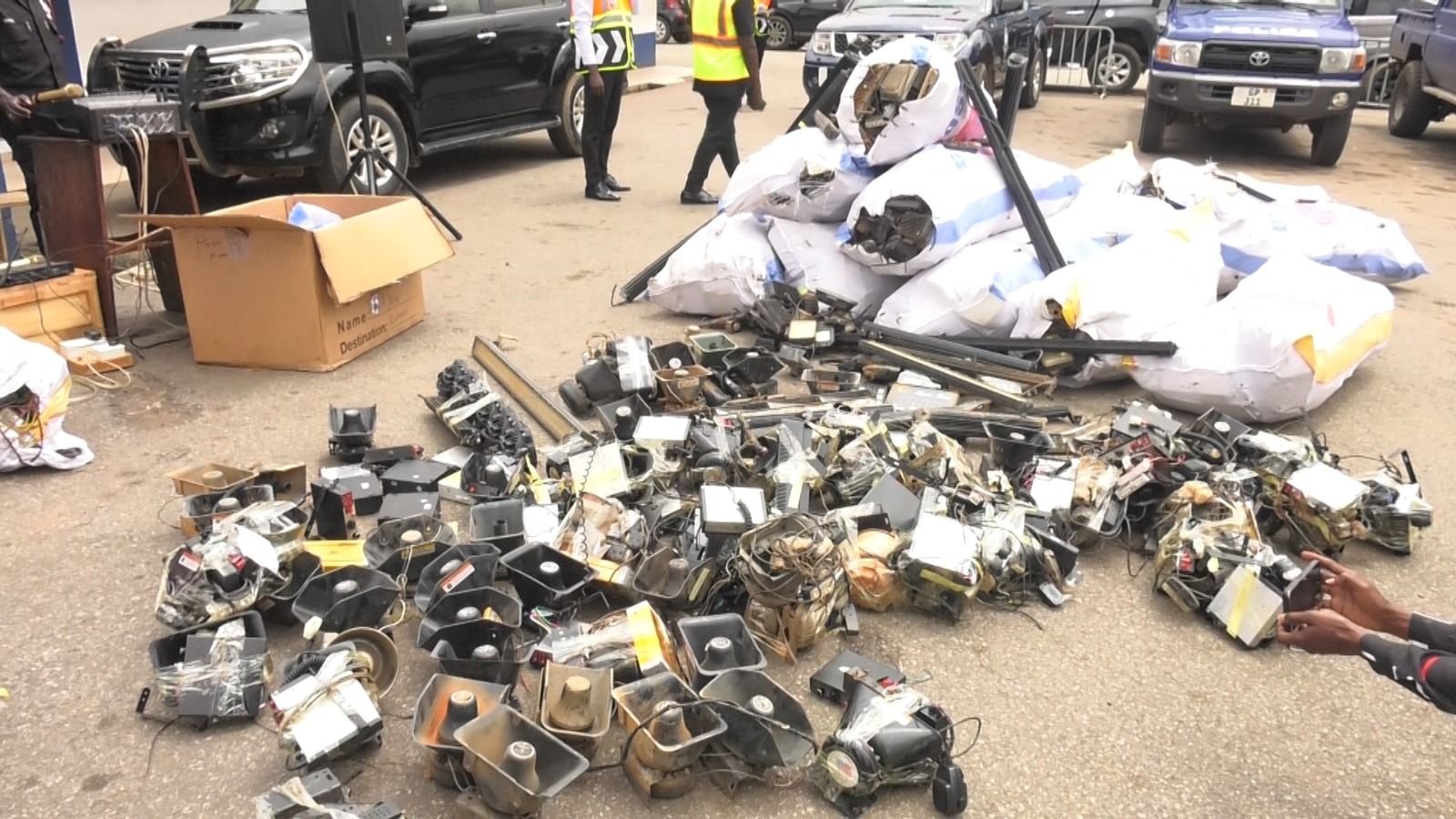
On the rivers, the committee changed its approach to dredging equipment. Rather than burning the engines of dredging platforms, which allowed miners to replace them within a day, it worked with a trained diving and salvage organisation to tow entire rigs away from the water to depots.
The miners lost all their equipment in those operations, which Prof Frimpong-Boateng says proved effective.
Why it was not sustained
The system was not adopted by all the agencies involved. The Forestry Commission refused to migrate onto the platform, while the Minerals Commission engaged with it only half-heartedly.
Prof Frimpong-Boateng says that failure explains more about galamsey than any description of an individual mining pit.
He also points to a Cabinet directive issued on 28 February 2019, after ministers had received an update on the committee’s work.
The Minister for Lands and Natural Resources was instructed to suspend the issuing of all new prospecting licences by the Forestry and Minerals Commissions. Existing licences for operations in 47 forest reserves were also to be suspended until environmental impact assessments had been completed.
The instruction was sent in writing on 4 March 2019, but was not implemented. The destruction continued.
Prof Frimpong-Boateng says monitoring systems can only work when institutions are prepared to be monitored. Similarly, a Cabinet order has little effect if those responsible for carrying it out are allowed to ignore it.
He argues that the technologies suggested by Mr Dablah are available and useful. Their weakness is not technical capability, but institutional adoption.
Agencies, ministries and influential licence holders must be willing to be observed, measured and, where necessary, punished. Without that commitment, he says, a system remains an aspiration rather than a functioning mechanism.
Areas where the proposal goes further
Prof Frimpong-Boateng says he does not want to respond to Mr Dablah merely by claiming that Ghana acted first. He accepts that the essay goes beyond the earlier system in three important areas.
The first is the process by which illegal gold is converted into legitimate money.
The system developed under his committee was strong at identifying mining sites but did little to track how gold moved through aggregators and refiners before export. It did not establish traceability from the mine of origin, comprehensive due diligence on aggregators and refiners, export controls or financial investigations that followed wealth up the chain rather than stopping with the miner.
Much of that work also fell outside the mandate of the ministry he led.
Prof Frimpong-Boateng agrees that making illegally produced gold difficult to monetise is more important strategically than simply making illegal mining harder to carry out.
The second gap is ecological accounting. Ghana calculates gold production, export income and foreign exchange in great detail, but has no national account that records a destroyed watershed as a financial liability.
Unless environmental destruction is entered on the national balance sheet as a genuine economic cost, extraction will continue to be presented as wealth creation. Prof Frimpong-Boateng says Mr Dablah is right on that point.
The third issue is benefit-sharing. The committee ran alternative-livelihood programmes, which Prof Frimpong-Boateng continues to support, but he says vocational education is not the same as giving communities a genuine stake in the mineral resources beneath their land.
The supply of people willing to work in illegal mining is an economic issue before it becomes a criminal one, he argues. Policing alone cannot remove that economic reality.
Measures now being introduced
Prof Frimpong-Boateng says the debate remains highly relevant in 2026.
The Ghana Gold Board is currently tendering for a blockchain-based track-and-trace system. It is intended to be operational by the end of the year and would connect every gram of gold bought by the board to a verified mine of origin.
L.I. 2462, which allowed mining in forest reserves, has been revoked. Restrictions on the importation of excavators and the tracking of excavators have also been reintroduced.
Those are the same measures that were directed in the third quarter of 2018 but, according to Prof Frimpong-Boateng, were never enforced.
The Forestry Commission has now published a satellite-based assessment showing that 8,923.8 hectares across 45 forest reserves and a national park had been damaged by the end of 2024.
Prof Frimpong-Boateng welcomes the developments, regardless of which administration introduced them. However, he warns that the outcome will depend on how consistently the new measures are applied.
A traceability system, he says, is only as reliable as the institutions prepared to be controlled by it. If licensed operators can pay to pass contaminated gold through their own permits, the system could simply provide a more accurate record of false origins.
The question facing Ghana
Prof Frimpong-Boateng says Mr Dablah could not reasonably have known about the earlier work because GalamSTOP was never properly documented for public access.
The state did not publish an account of the committee’s methods. The information that became available came from a report written by Prof Frimpong-Boateng in March 2021 for internal use, which reached newspapers two years later.
He says the report was then treated as a list of accusations rather than as an explanation of the system that had been developed.
A government that fails to preserve and publish its institutional memory should not be surprised when people later propose building systems that have already been created and abandoned, he argues.
Mr Dablah’s central question is how Ghana can redesign a national structure in which destroying a river can be profitable, politically survivable and economically rational.
Prof Frimpong-Boateng says that is the right question, but believes the main constraint is not technology and, to a large extent, not the law.
The decisive issue is whether enforcement bodies can be made independent and durable enough to act against the people they are required to challenge, including those responsible for appointing them.
Rivers cannot finance political campaigns, threaten elections or hire lawyers. Institutions exist to represent and protect things that cannot speak for themselves, Prof Frimpong-Boateng writes.
“Ours were captured by the things that can.”
By Prof. Kwabena Frimpong-Boateng