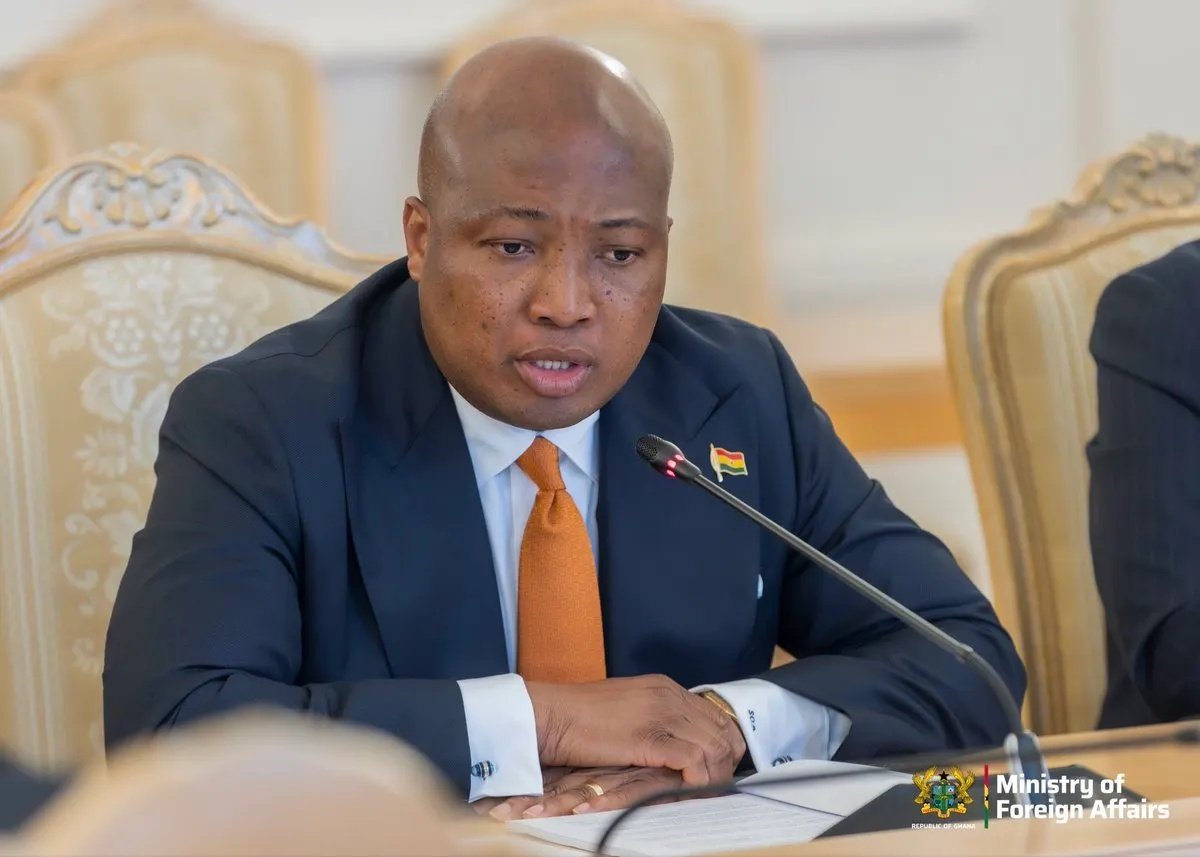
Ghana’s Cabinet has approved plans for the country to apply to join BRICS, Foreign Affairs Minister Samuel Okudzeto Ablakwa has announced.
The decision is part of the government’s strategy to widen Ghana’s economic choices and reduce its reliance on a limited group of international partners, according to Mr Ablakwa.
He said membership of the bloc could also strengthen Ghana’s relations with countries in the Global South and support greater South-South cooperation.
“The major highlight, which I am disclosing to the Ghanaian people for the first time, is that the Cabinet of President John Dramani Mahama has decided that Ghana will be joining BRICS,” he said.
Mr Ablakwa said Ghana viewed the organisation, which consists of major emerging economies, as a potential source of alternative economic and diplomatic partnerships.
“We believe that joining India in BRICS will give us economic options, will diversify our base and our partnerships, and will also allow us to have more cooperation within the Global South framework, as far as South-South engagements are concerned,” he added.
The announcement signals the government’s intention to build stronger links with emerging economies while broadening Ghana’s international economic relationships.
Mr Ablakwa also outlined plans to expand bilateral cooperation between Ghana and India in a number of areas, including railway development, pharmaceuticals, ICT, defence, agriculture, science and technology.
The two countries have signed two Memoranda of Understanding covering agriculture and science and technology. The agreements are intended to reinforce what the minister described as a comprehensive partnership between Ghana and India.
BRICS is an intergovernmental organisation and geopolitical coalition made up of 11 core member nations: Brazil, China, Egypt, Ethiopia, India, Indonesia, Iran, Russia, Saudi Arabia, South Africa, and the United Arab Emirates.
It also includes 10 partner countries. Together, the group represents roughly 49.5% of the global population and 40% of world GDP.
The organisation operates as an informal economic bloc intended to amplify the influence of the Global South and provide a counterbalance to institutions dominated by Western countries.