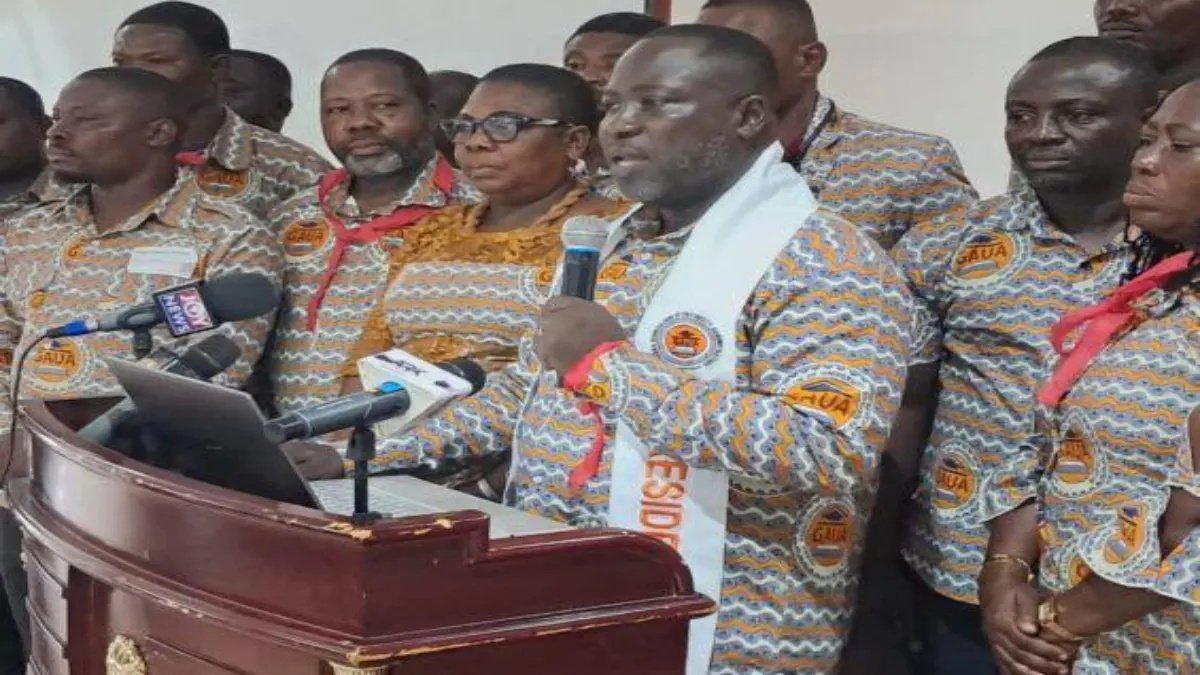
The Ghana Association of University Administrators (GAUA) will not decide whether to suspend its strike until it has received and reviewed a letter from the Fair Wages and Salaries Commission addressing the association’s outstanding concerns.
GAUA President Rev. Kwaku Karikari Amoah made the comments after meeting Education Minister Haruna Iddrisu on Monday October 12, 2026. The minister urged the association to return to work by the weekend so academic activities could resume on Monday, October 18.
Speaking to TV3’s Evelyn Tengmaa a day later, Rev. Karikari Amoah said progress had been made but the association was not yet fully satisfied.
“We cannot say that we are entirely satisfied. We can only be satisfied when the letter that is expected from the Fair Wages and Salaries Commission is seen, read, reviewed and approved,” he said.
He estimated that about 80 per cent of the issues behind the industrial action had been addressed, with the remaining 20 per cent expected to be resolved by Friday. He said GAUA was ready to continue negotiations if invited by the commission.
“If they call us, we are ready,” he said, adding that he was in Accra and prepared to meet the relevant authorities.
Members have been briefed on the meeting with the education minister, but a formal decision will only be taken after the commission’s letter is considered by GAUA’s National Executive Council (NEC). The association’s constitution requires internal procedures to be followed before a strike is suspended or called.
Rev. Karikari Amoah said the document would form the basis of an online NEC consultation with members, after which GAUA would announce its position.
He rejected claims that the association had completed negotiations and signed an agreement before changing its position. He said the market premium issue remained unresolved, citing a government white paper and a 2012 arbitration ruling on the application of market premium to senior university members.
According to him, the commission’s earlier letter referred to a revised market premium, while an arrangement involving the University Teachers Association of Ghana (UTAG) concerned a new market premium. GAUA believes the established procedures for determining the premium were not followed.
“We have not negotiated with you on market premium. So why do you tell us you are giving us a revised market premium?” he asked.
He also said GAUA had not approved an interim market premium arrangement and that any agreement must comply with the relevant arbitration ruling.
On concerns over further disruption to the university academic calendar, Rev. Karikari Amoah said staff welfare was essential to maintaining academic activities.
“The academic calendar is as important as the people who maintain the academic calendar,” he said.
He pointed to duties such as preparing and printing examination questions, arguing that dissatisfied staff could struggle to carry out those responsibilities. He added that disruption could be managed, as demonstrated during the COVID-19 pandemic, and noted that GAUA members also had personal and family interests in keeping universities running, including children enrolled in tertiary institutions.
He further clarified that the dispute over retirement was not simply about protecting individuals who had reached retirement age. GAUA was challenging what it viewed as a change to the established practice of allowing staff who turned 60 to remain in post until the end of the academic year.
He gave the example of an employee who turned 60 in March but would previously have completed assigned duties before retiring. Directives requiring non-teaching staff to retire in the month they turned 60, he said, could alter their conditions of service.
Rev. Karikari Amoah also questioned why teaching and non-teaching senior members were being treated differently, since both contributed to the university system and belonged to the university convocation.
“We are all senior members, so why do you want to treat some senior members differently from others?” he asked.
Despite the unresolved matters, he said GAUA remained optimistic that its demands would be met and members could return to work. If the commitments made during discussions were not fulfilled, the association would seek further talks with the education minister.
“We are very optimistic that our demands should be met,” he said, while warning that GAUA could take further action if the outstanding issues were not resolved.