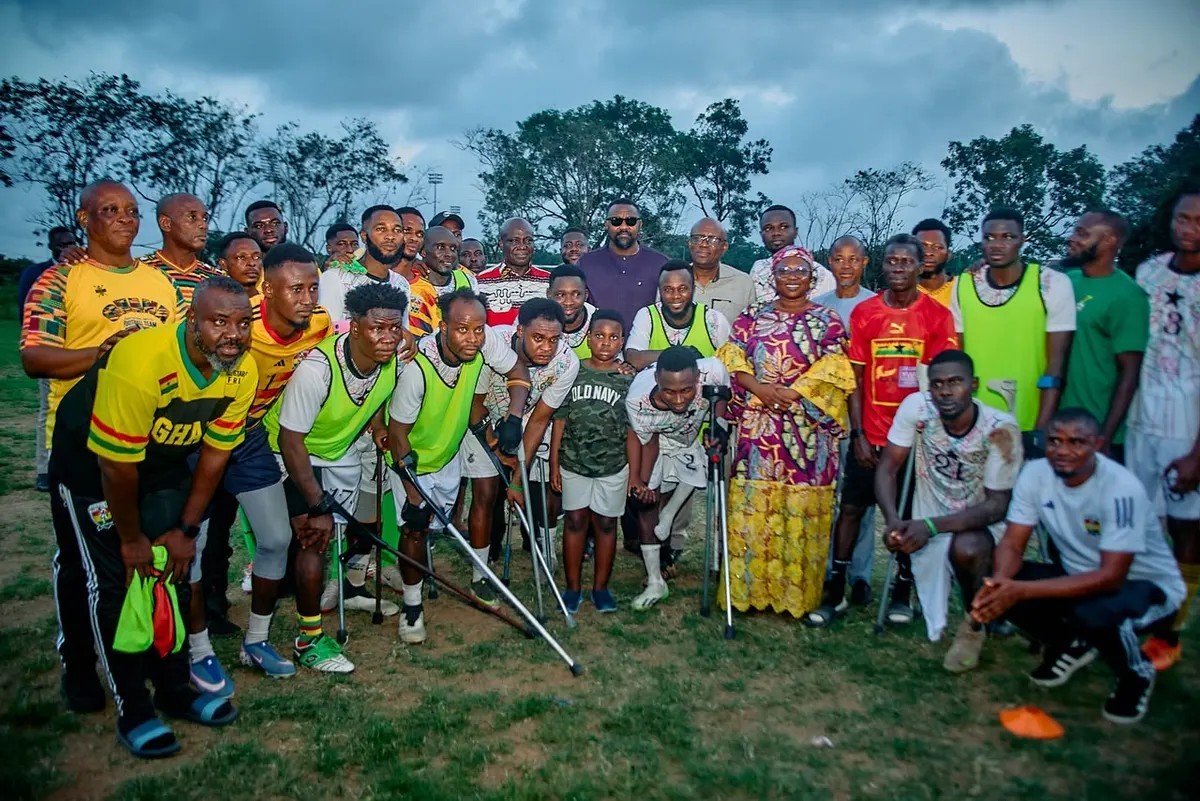
Minister for Food and Agriculture Eric Opoku has donated GH¢50,000 to Ghana’s national amputee football team, the Black Challenge, and promised to help its eight locally based players start poultry businesses after the 2026 Amputee Football World Cup.
The pledge adds an economic empowerment element to Ghana’s preparations for the tournament in Mexico, linking the team’s sporting ambitions with opportunities for players to build livelihoods through agribusiness.
Opoku visited the squad during a training session at the University of Ghana, accompanied by Deputy Minister John Dumelo, the ministry’s Chief Director and its budget officer.
He said the delegation’s visit was intended to demonstrate national backing as the players prepared to represent Ghana internationally.
“You are going to hold the flag of Ghana, and our presence here indicates that the whole nation is behind you,” he told the team.
“You are stronger than you know,” Opoku added, urging the players to approach the competition with confidence and make the country proud.
The minister said the Black Challenge required both encouragement and financial assistance before announcing the GH¢50,000 contribution.
His donation follows GH¢100,000 given to the team by dancehall artiste Stonebwoy, taking the combined value of the two contributions to GH¢150,000 as Ghana prepares for the tournament.
Opoku also said the eight players based in Ghana would be enrolled in the government’s Nkoko Nketenkete poultry programme. He said a tailored package would be developed for them following their return from Mexico.
“When you return, we want the players to be part of our Nkoko Nketenkete programme. We’re putting together a special package, so as soon as you return, get in touch with us,” he said.
The proposed scheme is intended to connect the players’ role in representing Ghana through sport with the government’s broader agricultural development plans.
If delivered with appropriate training and suitable production facilities, the initiative could show how national agricultural programmes can support Para athletes as business owners and food producers.
It could also offer a model for cooperation between sports organisations and agricultural agencies, extending athlete welfare to employment and business opportunities during and after sporting careers. Business advice and continued technical support would be important to making the approach sustainable.
Ghana have been drawn in Group D of the World Amputee Football Federation tournament alongside Angola, Colombia and Iraq.
The competition will take place in San Juan de los Lagos, Mexico, from 13–22 November 2026, with 24 national teams competing for the title.
“We are here to be part of your story,” Opoku told the players.