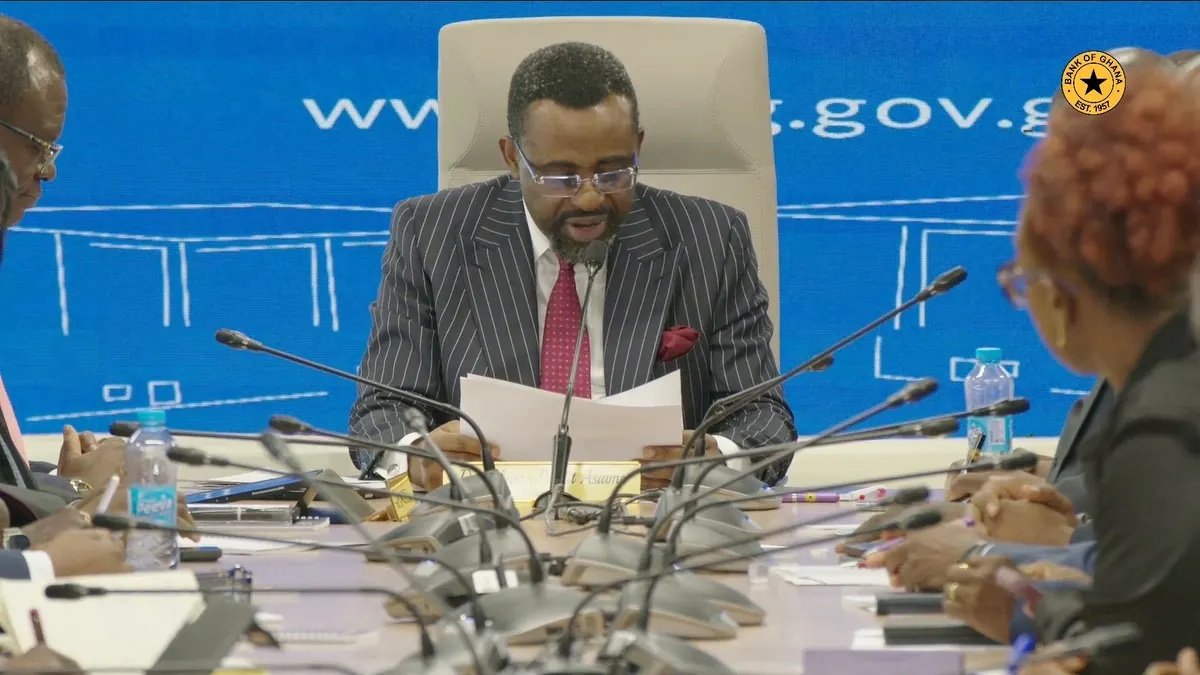
The Bank of Ghana has warned banks that technological progress must not undermine integrity, accountability or the stability of the financial system.
Governor Dr Johnson Pandit Asiama issued the warning in an address to the Chartered Institute of Bankers, Ghana’s 30th National Banking and Ethics Conference. The speech was delivered on his behalf by the Bank’s communications director, Bernard Otabil.
The two-day conference was held at Aqua Safari Resort on 9 and 10 November under the theme “Banking on the Future: Trust, Technology and Transformation”. The event focused on strengthening professional and ethical standards as artificial intelligence and virtual assets reshape the banking sector.
Dr Asiama said developments ranging from mobile money to artificial intelligence were transforming how financial services are designed, delivered and accessed. While those changes could reduce costs and bring more customers into the financial system, he said they also created important ethical challenges.
He pointed to growing concerns over privacy, consent and confidentiality as banks make greater use of customer data. The use of artificial intelligence in lending, customer profiling and fraud detection, he added, required safeguards to prevent bias, discrimination and unfair decisions.
“Innovation should advance the interests of customers and the economy, but it must not weaken the principles of integrity, accountability and financial stability,” he said.
Ethical considerations, Dr Asiama said, should be built into new financial products from the beginning rather than addressed after they had been developed.
On virtual assets, he called for a balanced regulatory approach to cryptocurrencies, stablecoins and tokenised products that would support responsible innovation. That approach must also address money laundering, terrorist financing, cyber vulnerabilities and market abuse, with Ghana’s Virtual Asset Service Providers Act, 2025, or Act 1154, providing the legal foundation.
Dr Asiama also described cybersecurity as an issue of ethics and governance, as well as technology. He warned that the weakest point in a bank’s defences could sometimes be an individual within the institution. The Bank’s Financial Industry Command Security Operations Centre currently provides threat intelligence to 23 banks.
He referred to Ghana’s 2017 to 2019 financial sector clean-up, saying weak governance and unethical behaviour had contributed to the collapse of several institutions. Even a bank with sufficient capital and advanced systems could remain exposed if its leadership lacked integrity, he said.
The Corporate Governance Directive of 2018 and the Fit and Proper Persons Directive of 2019 were identified as part of the Bank of Ghana’s response to those failures.
The Ghana Association of Banks and CIB Ghana are also working on a virtual-assets certification programme for bankers, based on the industry’s code of ethics.
Dr Asiama said supervision alone could not replace the responsibility of banks to behave ethically. Integrity, he said, had to guide every decision and be maintained at all times, “not merely observed when regulators are present.”