Researchers have called for greater domestic investment in health research, including financial support from local philanthropists and private-sector organisations, to help Ghana achieve health sovereignty.
Changing weather patterns could affect the spread of disease-carrying vectors, making research and surveillance increasingly important in identifying emerging health threats and developing effective responses.
The country’s ability to deal with those challenges will depend partly on the strength of its research institutions and whether they have reliable funding to continue their work.
Professor Kwadwo Asamoah Kusi, an immunologist at the Noguchi Memorial Institute for Medical Research, said Ghana needed to build the capacity to finance its own research. He also called for more investment in developing products that could generate income and help research institutions become self-sustaining.
He said producing practical products, rather than focusing only on academic publications, would be essential to creating an independent and sustainable health research system.
“Funding is always a challenge when you don’t have the money and the resources to do [the work]. This is something that we need to look at as a country. How can we fund our own research? Otherwise, we are coming back to that same point. Most of the research that we are doing is being directed from outside. We need to be able to get to the point where we can fund our own research and probably do what we call product development alongside that would generate the resources to be self-sustaining,” he said.
Professor Dorothy Yeboah-Manu, Director of the Noguchi Memorial Institute for Medical Research, said the government’s contribution should be supported by local philanthropists. She stressed that responsibility for financing health research could not be placed entirely on the state.
“The government has set up the National Research Fund, but we need also philanthropists. For example, if you look at Noguchi, we have a good drug discovery platform that is between Noguchi and the Department of Biochemistry against malaria. It’s being funded by the Gates Foundation, that’s a philanthropist, a rich man from US who is doing that. We need local philanthropists also to fund research,” she said.
Kwamena Essilfie Quaison, Director of Science and Technology at the Ministry of Environment, Science and Technology, said the government remained committed to improving the research capacity of the Noguchi Memorial Institute.
“We must acknowledge that research excellence cannot be sustained by individual scientists alone. It requires a supportive national ecosystem. Such an ecosystem must be underpinned by sustainable research financing.”
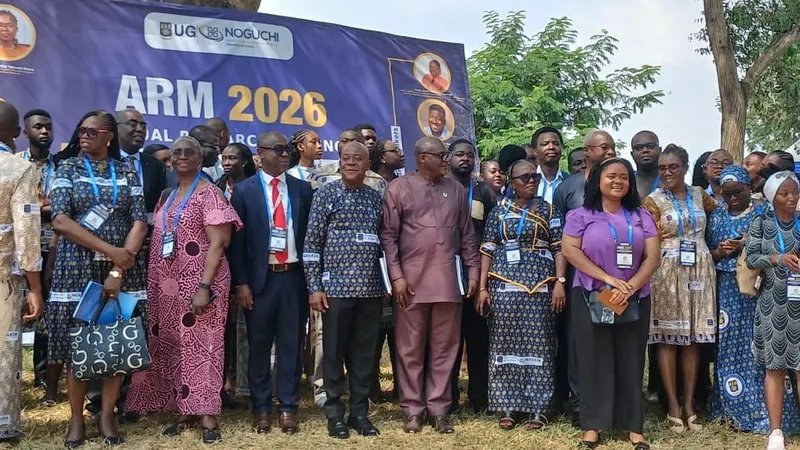
The comments were made during the Annual Research Meeting of the Noguchi Memorial Institute for Medical Research. The meeting was held under the theme, “Strengthening African-Led Research For Global Health Security”, with the aim of broadening and strengthening health research in Ghana.