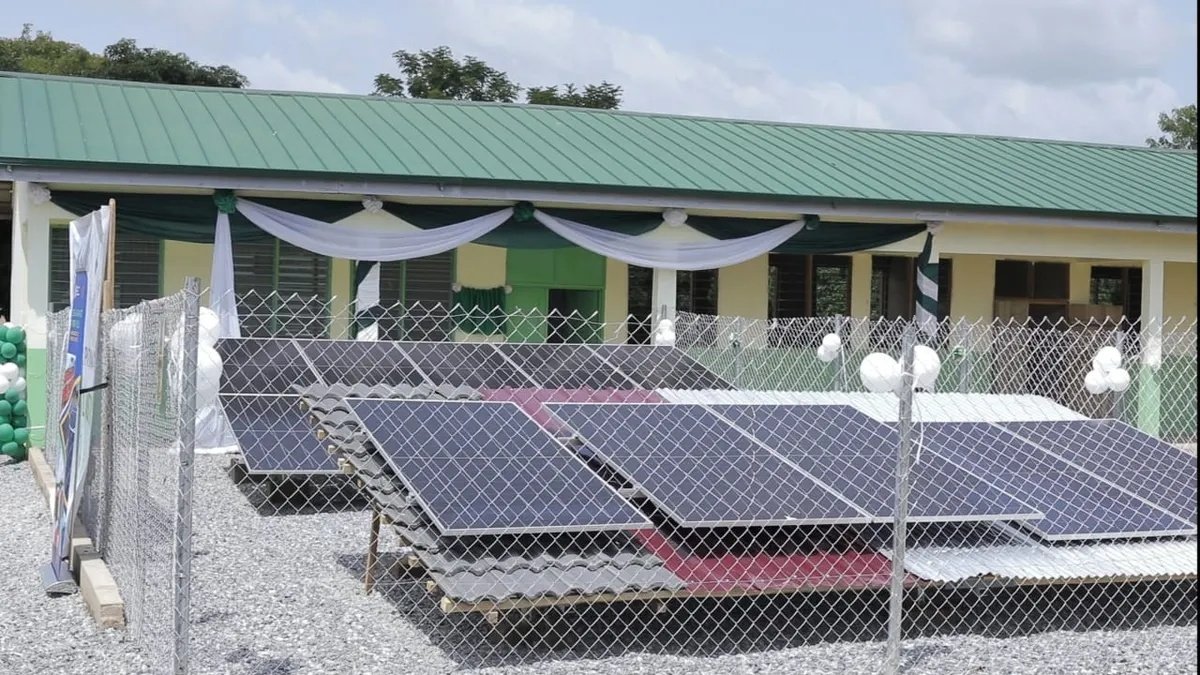
Wa Technical Institute in Ghana’s Upper West Region has opened a Solar Photovoltaic (PV) Training Centre designed to give about 100 electrical trainees practical renewable energy skills within a year.
The centre was established through the EU-Ghana Pact for Skills Integrated Action on Green Jobs and Skills, with support from the European Union (EU) and implementation by the International Labour Organisation (ILO), in partnership with the Ghana TVET Service and other organisations.
The facility will provide practical training in solar installation, maintenance and fault-finding, helping prepare young people for employment and entrepreneurship in Ghana’s expanding green economy.
At the commissioning ceremony, Wa Central MP and Minister of State in charge of Special Initiatives at the Presidency, Dr Hassan Rashid Pelpuo, said the project should strengthen the connection between technical education, renewable energy and decent work.
He said its impact would depend not on the ceremony itself but on the standard of training and the opportunities available to those who complete it.
“The real test of this investment will not be what we see at the ceremony but what follows: the quality of training provided, the competence of graduates, the services we provide and opportunities they can create,” Dr Pelpuo said.
He urged the institute and its partners to make the equipment part of routine practical teaching, support instructors and monitor students’ technical abilities, workplace experience and progress into employment or self-employment.
Gisela Spreitzhofer, team leader for Governance and Security at the European Union Delegation to Ghana, said the project was part of wider EU-Ghana cooperation aimed at improving technical and vocational education and training, tackling youth unemployment and meeting changing labour market needs.
“This is exactly the logic behind our support to the TVET system: providing modern equipment for hands-on learning, strengthening instructors’ capacities, improving curricula, promoting competency-based training and building partnerships with industry,” Dr Phala said.
Spreitzhofer added that green and digital skills were becoming more important as economies moved towards cleaner energy and technology-based industries.
ILO Country Director Dr Vanessa Phala-Mop said the initiative included more than equipment, combining solar PV facilities with instructor training, curriculum support, practical installation work and improved digital connectivity.
“The success of this facility should therefore not be measured simply by the quality of the equipment that we have employed and installed. It should be measured by the number of the young people who gain useful skills, who complete quality training, and move into employment, or create employment themselves and become entrepreneurs,” Dr Vanessa stated.
She called for more women to enter renewable energy and other technical careers, saying Ghana’s green transition should benefit both men and women.
Wa Technical Institute principal and Acting Regional Director of the Ghana TVET Service, Saaka Adams, said the centre would address the institute’s previous reliance on textbooks, marker boards and outdated equipment.
“Imagination alone cannot make a technician. At some point, hands must touch wires, and eyes must watch a system come alive,” Mr Adams said.
Management plans to maintain the facility, secure accreditation for its solar PV programme and build links with renewable energy companies. Mr Adams also appealed for EU and ILO support to extend solar power beyond one classroom to the rest of the building, which has about eight classrooms, and to renovate the girls’ dormitory and add sanitation facilities for female students.
The ceremony included symbolic tree planting to mark the institute’s commitment to environmental sustainability.
Story by Ibrahim