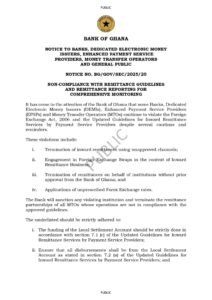
The Bank of Ghana has issued a stern warning to financial institutions, money transfer operators (MTOs), and electronic payment service providers over persistent violations of remittance regulations, despite multiple cautions.
In a public notice, the central bank cited breaches such as the use of unapproved remittance channels, engagement in foreign exchange swaps without clearance, termination of remittances on behalf of institutions without prior approval, and the use of unsanctioned forex rates.
“These violations pose a serious threat to the transparency and stability of Ghana’s foreign exchange and remittance ecosystem,” the statement read.
The Bank warned it will take firm action, including the termination of partnerships with any MTOs or service providers that continue to flout its updated guidelines.
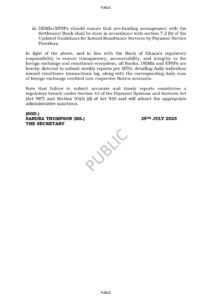
To improve oversight and enhance accountability, the regulator has now mandated all banks, Dedicated Electronic Money Issuers (DEMIs), and Enhanced Payment Service Providers (EPSPs) to submit weekly reports per MTO. These reports must include a daily inward remittance log and the sum of foreign exchange credited into respective Nostro accounts.
Institutions were reminded that failure to submit accurate and timely reports constitutes a regulatory breach under Sections 42 of the Payment Systems and Services Act (Act 987) and 93(3)(d) of Act 930. Offenders will face administrative sanctions.
The notice, signed by Sandra Thompson, Secretary to the Bank of Ghana, also reiterated specific compliance procedures, such as funding and disbursement rules for local settlement accounts, in accordance with Sections 7.1 and 7.2 of the updated remittance guidelines.
This move comes amid growing efforts by the central bank to tighten control over Ghana’s financial system and curb foreign exchange leakages.
Read full statement below