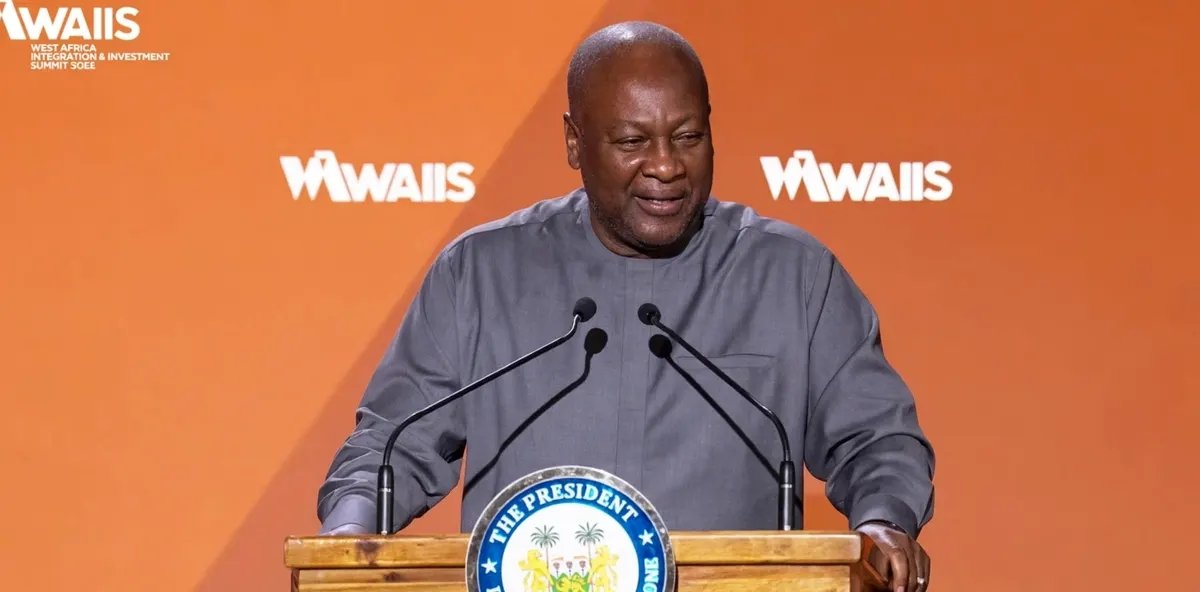
President John Dramani Mahama has called on West African leaders to use the West Africa Integrated Investment Summit (WAIIS) 2026 to turn decades of stalled promises on regional integration into practical action.
Speaking at the Plenary of Heads of State and Global CEOs Investment Roundtable in Freetown, Sierra Leone, he said the summit should provide the “key” to remove the political and economic barriers holding back ECOWAS.
Mahama congratulated Sierra Leone President Julius Maada Bio for quickly establishing the summit, which was placed on the ECOWAS agenda and formally endorsed as an ECOWAS function at a summit in June.
WAIIS brings together Heads of State, ministers, investors, development finance institutions, business leaders and project owners to link regional priorities with capital and investment-ready projects. President William Samoei Ruto of Kenya and Faure Gnassingbe, President of the Council of Ministers of the Togolese Republic, are also attending.
Mahama led discussions on “Energy, Minerals and Industrial Value Chain” and chaired a session examining which generation and cross-border transmission projects are closest to construction.
He praised President Bio for continuing to promote integration after transferring the ECOWAS Chairmanship to Senegal.
“Regional leadership goes beyond tenure,” Mahama said, arguing that ECOWAS, founded in 1975, had remained too focused on meetings between Heads of State rather than becoming an organisation owned by its people, particularly young people.
He said political will was needed to overcome known obstacles, rather than further “lip service” to integration.
The ECOWAS Trade Liberalisation Scheme (ETLS), agreed in 1990, was cited as an example. It allows qualifying manufactured goods with at least 60% local content to move without duty when accompanied by an ETLS certificate, but non-tariff barriers continue to frustrate traders travelling between Freetown, Accra and Lagos.
Mahama said trade within West Africa had remained between 12 and 15% for many years. He also said Ghanaian businesses had been asked for NAFDAC certificates at the Nigerian border despite holding ETLS certificates.
Governments, he added, should create the conditions for private investment rather than operate businesses themselves. Macroeconomic stability, the rule of law, democracy, accountability and infrastructure were essential, while the Africa Finance Corporation and African Development Bank should help provide low-interest finance.
On agriculture, Mahama said West Africa’s arable land had not prevented it becoming a net food importer. Ghana imports $3 billion of food products annually, including rice and poultry, while palm oil is imported from Malaysia and Indonesia despite oil palm originating in West Africa.
“Any time we eat that foreign rice or we eat the foreign chicken, we are exporting value and importing poverty,” he said, crediting Aliko Dangote with the phrase.
He also called for African minerals to benefit local populations. Ghana’s artisanal and small-scale mining gold output rose from 64 tons worth $4.6 billion in 2024 to 104 tons generating $10.8 billion after the Ghana Gold Board law was introduced. Royalties have moved from 3% to a sliding scale of 5% to 12%, with GH¢7.8 billion paid by large-scale gold mining since the law was passed.
Mahama said only 7% of electricity is exchanged through the West African Power Pool, although Ghana has about 2,000 megawatts of surplus power. He believes regional electricity exchange could reach almost 30 percent within five years if interconnections improve.
He also criticised delays to the Abidjan-Lagos corridor, first proposed in 1998-99, and urged countries ready to adopt the ECO common currency to begin using it alongside national currencies for trade settlement.
WAIIS 2026 will focus on cross-border investment, power and clean energy, critical minerals, agriculture, digital transformation, climate change, food security, fair energy transition, and opportunities for women and young leaders.