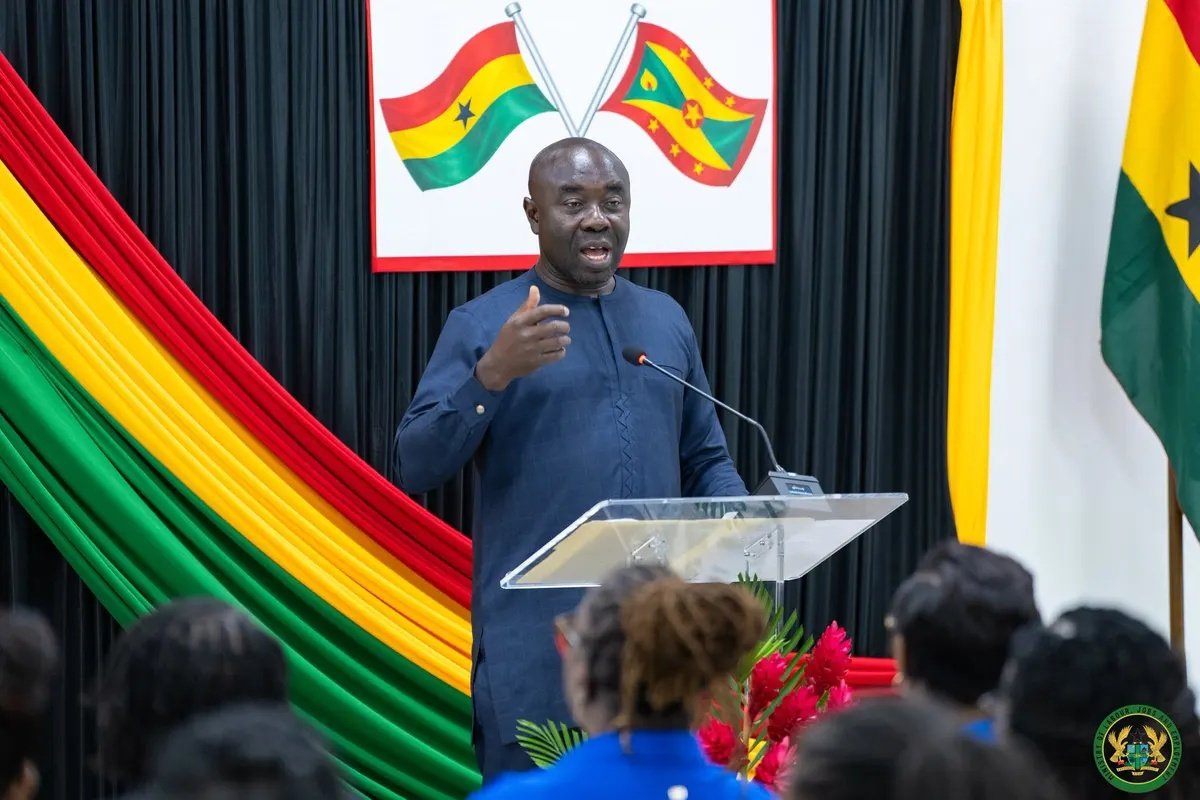
Labour, Jobs and Employment Minister Emmanuel Kwadwo Agyekum has urged electric motorcycle manufacturer Spiro to produce more components in Ghana, saying the move would create jobs and reduce the country’s reliance on imports.
Agyekum made the call during a visit to Spiro’s warehouse, where Managing Director Maxwell Dodd said the company’s operations could support about 2,000 jobs once they reached full capacity.
Spiro’s full rollout is scheduled to begin in January 2027, with production expected to reach 300 motorcycles a day.
“Creating jobs is not rocket science. It is doable,” Agyekum said.
Job creation has been the minister’s main priority since he met the Trades Union Congress (TUC) shortly after taking office in September. He also pledged government support for Spiro’s expansion.
Agyekum praised the company for employing young Ghanaians, including JHS and SHS leavers, and training them to assemble the motorcycles. He said manufacturing components domestically, rather than importing them, would reduce Ghana’s import bill while creating opportunities for local suppliers and skilled workers.
Figures released by the Ghana Statistical Service in December showed national unemployment at 13.0 per cent in the third quarter of 2025. The highest rate was recorded among people aged 15 to 24, at 32.4 per cent.
The minister has also sought employment opportunities overseas. Last week, he signed an agreement with Russia’s Alabuga Special Economic Zone to recruit Ghanaians for industrial employment.
Green mobility programme
Agyekum’s visit came after the Labour Ministry and WhiteCap Management Ltd announced a memorandum of understanding on Monday, November 2, for a five-year Green Mobility Programme. Under the agreement, Spiro Ghana will assemble and supply the vehicles.
The programme’s targets include 200,000 electric vehicles, made up of 100,000 Spiro two-wheelers and 100,000 electric three-wheelers. It also plans to establish 350 service centres supported by 1,500 battery-swapping stations.
A lease-to-own arrangement will allow customers to obtain vehicles without an upfront payment and repay the cost over 18 months.
The programme is expected to generate more than 3,000 direct jobs, along with over 205,000 indirect jobs and income opportunities. Its first phase aims to deliver 1,000 electric motorbikes by the end of 2026.
It is intended to cover all 261 metropolitan, municipal and district assemblies. The initiative will be privately financed, without government capital spending, while adviser DC L’Afrique Limited is seeking to raise US$65 million over five years.
The memorandum identifies legal approval for electric two- and three-wheelers used in commercial transport as a key opportunity. Commercial motorbike transport, known as okada, now has a legal framework under the Road Traffic Regulations, 2026 (L.I. 2519).
Dodd said riders could earn between GH¢400 and GH¢500 a day, while operating costs would be about 40 per cent lower than those of petrol motorcycles.
He said riders would be able to exchange depleted batteries for charged ones at stations operating around the clock, avoiding the need to wait for batteries to recharge. Spiro is also introducing savings and insurance schemes for riders.
Dodd called on the government to provide tax incentives and supportive policies to help the company expand beyond its current areas of operation.