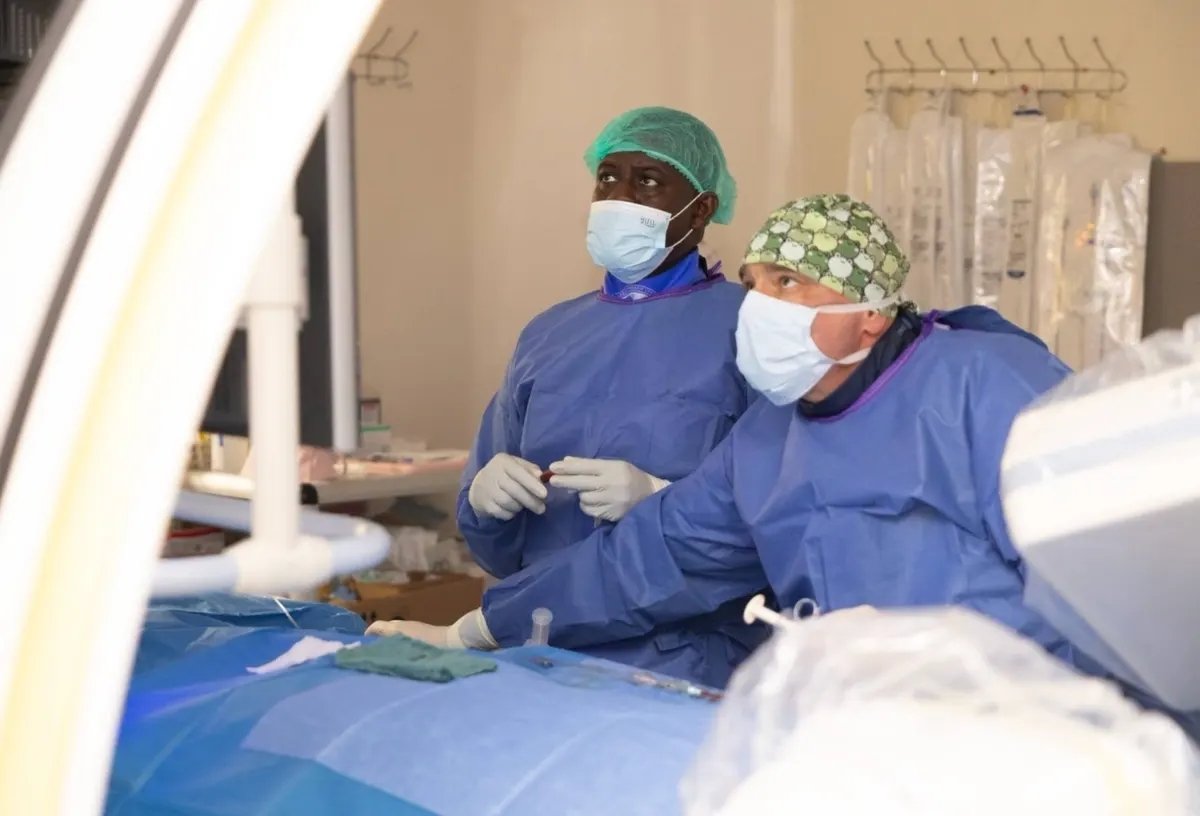
Doctors at Korle Bu have replaced a damaged pulmonary heart valve in a 14-year-old girl without opening her chest, in a procedure described as a first for Ghana.
The operation was performed at the National Cardiothoracic Centre (NCTC) and announced on Monday. Doctors inserted the replacement valve through a blood vessel in the girl’s thigh before guiding it to her heart.
The procedure took about one hour. Follow-up checks showed that she was recovering well and that the new valve was “functioning excellently”, according to Korle Bu.
She has been advised to rest for one week and avoid heavy lifting while the wound in her leg heals.
The technique, known as Transcatheter Pulmonary Valve Replacement, was used because the girl had severe pulmonary valve regurgitation. Doctors implanted a Harmony Valve, a device designed for patients with enlarged pulmonary arteries.
Unlike conventional open-heart surgery, the procedure does not require the chest to be opened. That makes it less invasive and may allow patients to recover more quickly.
The operation was carried out during this year’s partnership visit to the NCTC, involving about 30 doctors, nurses, physician assistants and intensive care staff. The visiting team also performed open-heart operations and catheter procedures on children born with heart disease.
The work was a joint effort between the NCTC and German organisations Kinderherzen International and the Gerald Asamoah Foundation.
Dr Katja Pauli, who led the German team, said heart conditions needed to be identified early and treated promptly. She said isolated pulmonary valve insufficiency could occur even when a patient had no other heart disease, making thorough assessment and regular check-ups important.
Some heart conditions can also be detected during pregnancy, Dr Pauli added, highlighting the importance of early screening and prompt medical care to improve treatment outcomes.
NCTC director Dr Kow Entsua-Mensah described the operation as a significant milestone in the centre’s efforts to provide advanced heart treatment in Ghana.
He said Ghana was now among the countries able to perform the procedure and described the Harmony Valve as an advance in transcatheter valve technology that was gaining acceptance around the world.
The partnership has also enabled babies and children to receive catheter procedures and surgery at the centre’s new catheterisation laboratory, which replaced its former facility.
Further procedures are planned, including treatments to close a patent ductus arteriosus (PDA) – an abnormal connection between two major blood vessels near the heart – and an atrial septal defect (ASD), a hole between the heart’s two upper chambers.
Parents of children treated during the visit thanked the Ghanaian and German teams. They said access to the specialist care free of charge, supported by the NCTC, the visiting team and the Ghana Medical Trust Fund, had brought them hope and relief.
Korle Bu said the procedure demonstrated that the NCTC could now undertake complex heart treatment locally, reducing the need for some patients to travel abroad for specialist care.