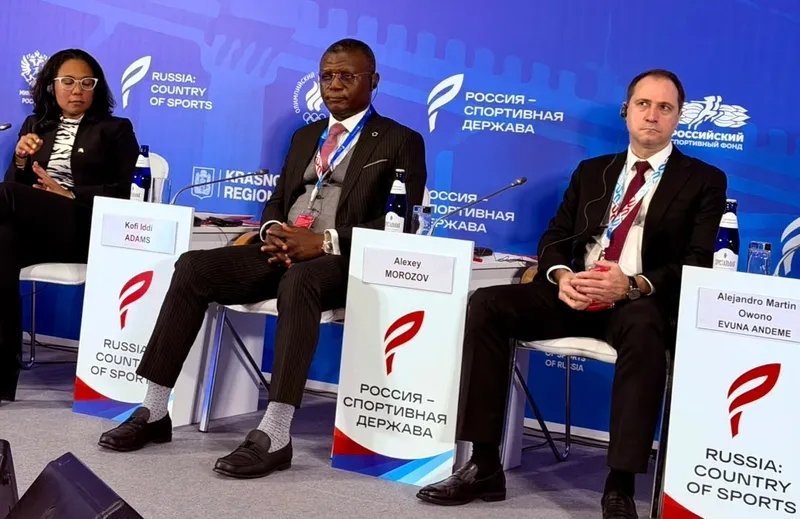
Ghana’s Minister for Sports and Recreation, Hon. Kofi Iddie Adams, has urged countries to make cross-border travel easier for athletes, strengthen fair anti-doping procedures and create reliable funding systems for sport.
Speaking at the “Russia–Africa: Together Towards Sporting Victories” panel during the 14th International Sports Forum “Russia: Country of Sports” in Krasnoyarsk, Mr Adams said stronger partnerships should help African countries build lasting sporting institutions and expand their economic capacity.
The forum took place from 21 to 23 October 2026, bringing together government officials, sporting organisations, investors and specialists to consider the development of professional and mass sport.
The Russia–Africa discussion was moderated by three-time Olympic champion Maria Kiseleva and included ministers and senior sporting representatives from Russia and several African countries.
Mr Adams said athlete mobility should be a central part of cooperation, linking the principle of a borderless Africa to practical access to training, competitions and professional exchanges. He noted that travel restrictions can reduce athletes’ exposure to opportunities and disrupt their development.
He also called for anti-doping systems that prioritise education, prevention and due process. While maintaining the need to protect clean sport, the minister said procedures must respect athletes’ rights and careers. He warned that overly punitive measures could end careers unnecessarily and stressed the importance of ensuring competitors understand and meet their responsibilities.
The minister pointed to the creation of the Ghana Anti-Doping Agency as an important step in improving sporting integrity and protecting athletes. Ghana’s approach includes clean sport education in schools, community clubs and academies, supported by coaches, parents and medical staff working with young athletes.
Ghana’s funding and development reforms
Mr Adams presented the Ghana Sports Fund as a response to long-running uncertainty over sports financing. Created under Act 1159 of 2025, the statutory fund is intended to mobilise resources for athlete preparation and welfare, infrastructure, school and grassroots programmes, and recreation.
Its role covers the period before athletes reach national recognition, when regular coaching, competition and medical care are vital to continued progress.
He also outlined the restructuring of school and grassroots sport through the Schools and Grassroots Sports Secretariat. The body is designed to link early participation with talent identification and further development, helping athletes move more consistently from schools and communities into sporting institutions.
The minister’s prepared remarks included plans for athlete tracking to preserve development records, expose gaps in support and improve opportunities for girls, persons with disabilities and underserved communities.
The reforms are also intended to grow the wider sports economy. Areas identified included apparel, training equipment, broadcasting, facility maintenance, digital platforms and professional services, with demand from sport providing opportunities for African businesses and employment.
Mr Adams said cooperation with Russia could support technical training, institutional exchanges and joint ventures designed to build that capacity within African countries.
Corporate support is another part of Ghana’s financing model. Under the country’s tax framework, qualifying donations to sports development and promotion may be deducted from income before tax is calculated, provided the necessary approvals and documentation are secured.
His contribution placed Ghana’s reforms within a wider African discussion about accessible opportunities, dependable financing, athlete protection and institutions capable of supporting progress beyond individual competitions.