Ghana is expected to generate about US$68 million from the sale of 6.5 million verified forest carbon credits, after international buyers committed an initial US$43 million, the Forestry Commission says.
The first four million credits have attracted around US$43 million, according to Forestry Commission chief executive Dr Hugh C.A. Brown. The buyers include members of the LEAF Coalition (Lowering Emissions by Accelerating Forest Finance).
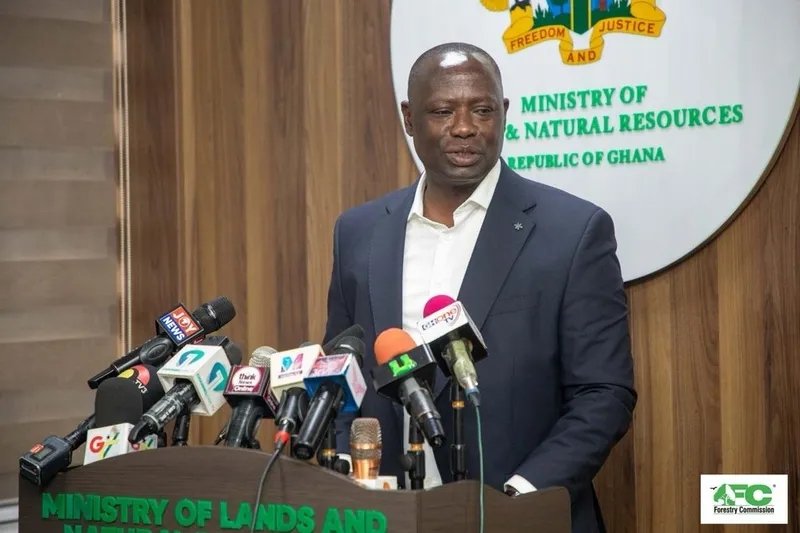
The figures were announced at a briefing in Accra on Monday by Dr Brown and Lands Minister Emmanuel Armah-Kofi Buah, following the issuing of the credits to Ghana.
A forest carbon credit represents one tonne of carbon dioxide prevented from entering the atmosphere, or removed from it, through the protection or restoration of forests after the result has been verified.
The initial transactions are priced at between US$10 and US$13 per tonne. That falls within the US$5 to US$25 range questioned in Parliament earlier in November by Minority Chief Whip Frank Annoh-Dompreh, who warned that Ghana could undersell its environmental assets.
A further 2.5 million credits could raise about US$25 million if sold on the open market, bringing the projected total to US$68 million.
Dr Brown cautioned that the money had not yet been received. The issuing of credits, he said, did not mean buyers had already paid.
How the revenue will be distributed
Ghana’s benefit-sharing arrangements allocate 46% of the proceeds to farmers, communities living on the edges of forests and traditional authorities. They are responsible for maintaining trees on cocoa farms and in forest areas.
Government institutions, including the Forestry Commission and district assemblies, will receive 39%. That share is intended to support forest protection, replanting, monitoring and land management.
The same structure was used to distribute approximately US$21.8 million received by Ghana between 2023 and 2024 through the Ghana Cocoa Forest REDD+ Programme, which was backed by the World Bank’s Forest Carbon Partnership Facility.
That funding supported the purchase of farm inputs and the construction of boreholes, CHPS health compounds and school blocks. It also paid for classroom furniture and the replanting of degraded land in the affected communities.
Credits follow years of verification
The board of the Architecture for REDD+ Transactions (ART) approved the issuance of 6.57 million credits under its REDD+ Environmental Excellence Standard (TREES) on 10 November.
The decision made Ghana the first African country, and the third globally after Guyana and Costa Rica, to receive jurisdictional credits under the standard.
The credits cover emissions reductions achieved between 2017 and 2021 across about 2.5 million hectares of forest and farmland. Ghana’s forest data and safeguards were independently audited by AENOR CONFIA S.A.
“We have taken this journey since 2008. Successive Governments have contributed to making sure we continue to protect our forests,” Buah told the briefing.
Dr Brown said the credits reflected results achieved by Ghana rather than an allocation.
“These credits were not simply allocated to Ghana. They were earned through results that had to be achieved, measured, reported, independently validated, and verified,” he said.
Dr Joseph Appiah-Gyapong, acting head of the commission’s Climate Change Unit, said future payments would depend on measured results. The next monitoring period covers 2022 to 2026.
Officials warned that galamsey, illegal logging, bush fires and agricultural expansion into forest areas could reduce future payments if forest loss increases. On Tuesday, armed men attacked a joint Forestry Commission and military team at Sefwi-Asawinso.