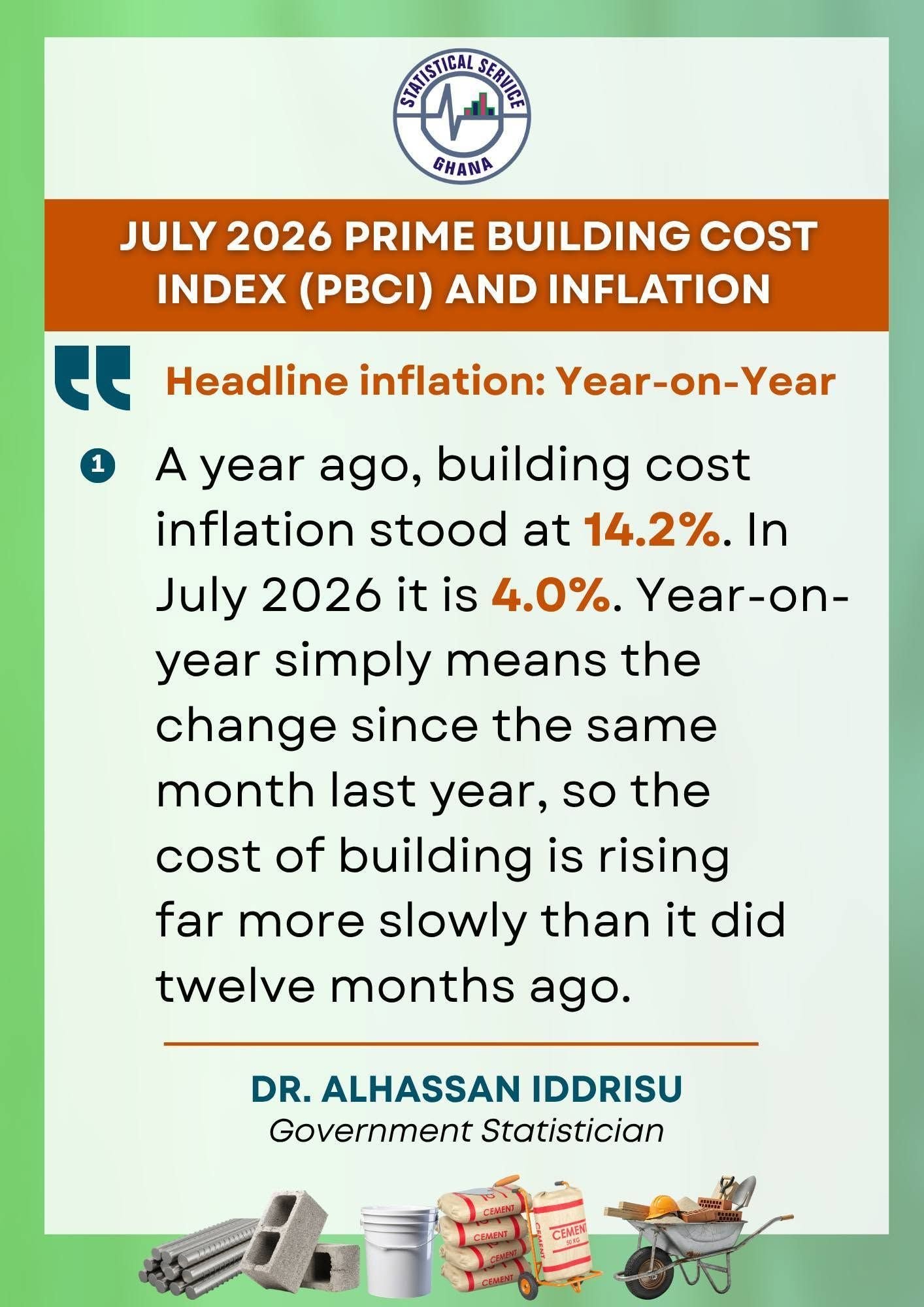
The cost of building in Ghana is increasing at a much slower rate than it was a year ago, with annual construction inflation falling from 14.2% in 2025 to 4% in 2026, Government Statistician Dr Alhasam Iddrisu has announced.
Speaking at a press conference in Accra on Wednesday, 26 August, Dr Iddrisu said the change represented a significant shift for households, contractors and planners across the country.
He explained that the year-on-year figure measures how prices have changed compared with the same month a year earlier. On that basis, construction costs are now rising considerably more slowly than they were 12 months ago.
Building input prices also recorded a modest increase in the latest monthly figures. Between June and July 2026, prices rose by 0.3%.
Dr Iddrisu said the month-on-month measure, which compares prices with those recorded just one month earlier, showed that construction costs were broadly steady, with only a gradual increase during the period.
“Materials make up more than three-quarters of the basket and rose 5.1% over the year, accounting for almost all upward pressure.
“But the sharpest rise is in plant (machinery and equipment), up 18.0%. This is the main risk we are watching,” he said.
The figures indicate that materials remain the biggest component of the construction cost basket and are responsible for most of the pressure pushing prices higher over the year.
However, machinery and equipment recorded the most pronounced increase among the categories monitored. The 18.0% rise in plant costs was identified by the Government Statistician as the main area of concern.
Dr Iddrisu also highlighted significant movements in several specific construction inputs.
“Plumbing recorded the fastest price rise at 25.3%, followed by small tools and roofing sheets.
“At the same time, cement fell 9.8% and steel 8.9%. Cheaper structural materials are partly offsetting costlier fittings and tools.
The figures show a mixed picture across the sector. Plumbing, small tools and roofing sheets have become more expensive, while the prices of cement and steel have declined.
Those reductions in key structural materials are helping to ease some of the impact of higher prices for fittings, tools and machinery. Even so, the annual cost of building remains above the level recorded a year earlier.
The fall in the annual rate from 14.2% to 4% means the pace of increase has slowed sharply, rather than indicating that all construction inputs have become cheaper. The monthly rise of 0.3% further suggests that prices were relatively stable between June and July 2026.
Dr Iddrisu said the latest figures provided an important indication of the changing cost pressures facing everyone involved in building in Ghana, including households, contractors and planners.