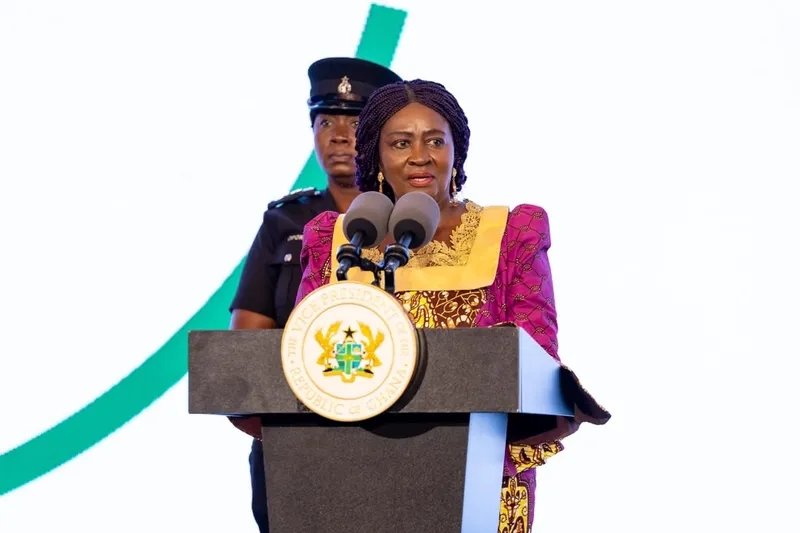
The Ghana Academy of Arts and Sciences has celebrated women whose leadership and work are contributing to Ghana’s development, while Vice President Professor Naana Jane Opoku-Agyemang called for stronger measures to overcome the obstacles still restricting women’s progress.
Speaking at the maiden Ghana Academy of Arts and Sciences Women’s Awards in Accra, she said women had played a central role in building the country long before they gained broad access to formal education and public office.
Women had contributed to agriculture, fishing, mining, trade, healthcare, leadership and warfare, Professor Opoku-Agyemang said, although much of that work had not been formally acknowledged.
“Women built communities. They farmed. They fished. Women mined. They produced goods, processed and traded,” she said.
She added that the arrival of formal education and colonial institutions opened new routes into employment and public leadership, but those opportunities were not equally available to women.
Education had since become one of the most important means of increasing women’s participation in professional and public life, she said. However, she warned that major challenges remained.
“For an earlier generation, the obstacle must have been access to the classroom. Today, it may be finance, professional advancement, leadership, decision making, or the courage to confront prejudice,” she said.
The Vice President said the government was introducing measures to widen women’s access to opportunities. Those included the Affirmative Action Act, the revised National Gender Policy and the establishment of a Women’s Development Bank.
She also urged the Academy to continue recognising women in rural and grassroots communities, whose work often receives less national attention.
Recognising work beyond the spotlight
Emerita Professor Isabella Akyinbah, president of the Ghana Academy of Arts and Sciences, said the awards recognised not only women whose achievements were already widely known, but also those making a substantial difference away from public attention.
She referred to this work as the “quiet factor” – the often unseen contribution of women that produces lasting and visible change in communities and institutions.
Professor Akyinbah said national development was not limited to Parliament, corporate boardrooms or other prominent settings. Women also helped solve problems, create opportunities and support others in markets, schools, clinics, communities and workplaces.
Recognising those contributions was important, she said, because it showed that leadership and excellence could come from every part of society.
The awards were held under the theme “Breaking Barriers and Building Nations: Celebrating Women in Outstanding Leadership in Ghana.”
The ceremony also highlighted the Academy’s history, including the contribution of its first female fellow, Dr Letitia Obeng, who delivered a lecture entitled Nation Building and the African Woman in 1972.
Professor Opoku-Agyemang said that, more than five decades later, the key challenge was ensuring women could use their abilities fully across Ghana’s institutions, economy and governance.
“It is on us to ensure that the opportunities available to women are as expansive as the contributions we have always expected them to make,” she said.
The inaugural awards therefore combined recognition for women who had broken barriers with a call for greater support for those whose daily work continues to help build Ghana.