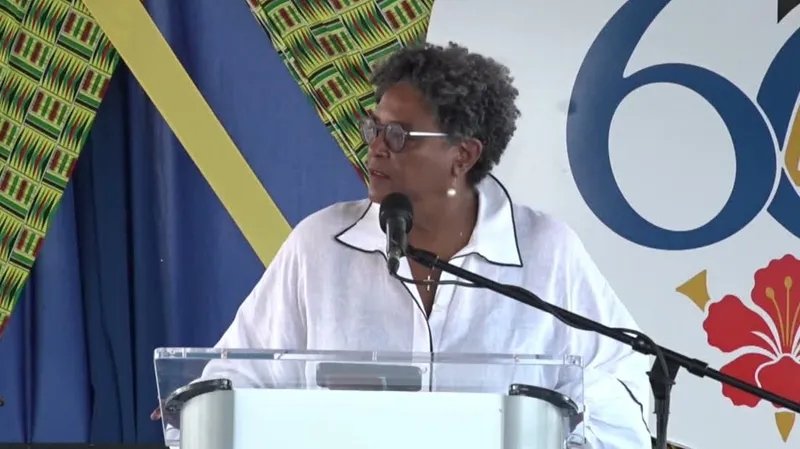
Barbados Prime Minister Mia Amor Mottley has praised Ghana for showing “moral courage” in pressing the international community to recognise the transatlantic slave trade as “the gravest crime against humanity”.
Speaking in the presence of Ghanaian President John Dramani Mahama, Mottley confirmed that Barbados would join the Global Africa Commission on Reparatory Justice, established by Ghana.
The announcement came during a ceremony on the Barbados coast, broadcast live by the Barbados Government Information Service, where Speightstown and Cape Coast formalised a twinning agreement and unveiled a bust of King Cuffee.
“Earlier this year, Ghana exhibited a moral courage for which I would want to salute you now on Barbadian soil,” Mottley told Mahama.
She said Ghana had encouraged the world to confront the history and consequences of enslavement. Accra has also promoted the creation of a broader Africa-Caribbean mechanism focused on reparations for slavery.
“We do not seek to live in the past, but we also do not believe that injustice should prevail,” Mottley said.
She called for discussions on reparatory justice with the United Kingdom to take place in a “structured, dignified manner”, adding that this position had been “settled at the last Commonwealth heads of government meeting”.
Mottley said the process of healing remained incomplete. She expressed hope that the discussions would help deliver justice and bring Barbadians, Africans and British people together around a shared purpose.
She also argued that colonial laws governing slavery had created a form of racism that continued to place nations on unequal terms.
Remembering resistance
Mottley rejected the description of the 1675 Speightstown uprising plot as a conspiracy, saying the colonial records failed to recognise the people involved as freedom fighters.
The planned revolt was led by King Cuffee, an enslaved Akan man from the Gold Coast. “We see them as freedom fighters,” Mottley said, describing the organisers as “patriots before there was a patria”.
She linked the uprising to a longer history of resistance in Barbados, including Bussa’s revolt in 1816, the introduction of universal suffrage in 1951, independence in 1966 and the country becoming a republic in 2021.
Mottley said republican status meant every Barbadian child could now imagine becoming head of state.
Mahama arrived in Barbados on Thursday for a state visit as the country marks six decades of independence and its fifth year as a republic.
Mottley backed his proposal for exchanges between schoolchildren in Cape Coast and Speightstown, promising that Barbados would support the initiative.
“President Mahama spoke of the importance of the exchanges of our school children, and we commit to that,” she said.
Referring to the Akan word Sankofa, which she translated as “go back and fetch it”, Mottley said the two countries were rebuilding connections across the Atlantic.
“We do not choose to dwell in pain, but we do not forget the pain that was put upon us,” she said.
She thanked Mahama, his delegation and Ghana’s foreign minister for helping to “carry this heavy weight”.
“A great cause must never be abandoned,” Mottley said, urging both countries to remain committed to “justice and solidarity”. She ended her address in Twi with the words “Medaase pa”.