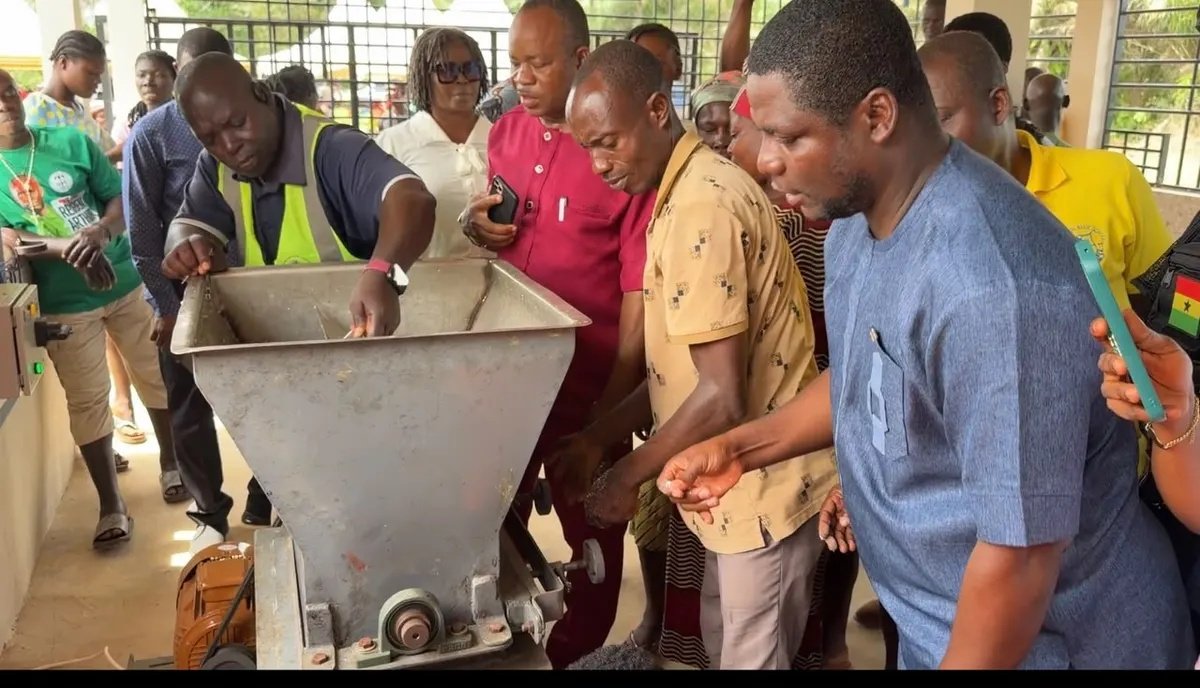
The future of a newly commissioned cassava processing factory in Apataim, in Ghana’s Western Region, is being questioned as expanding rubber plantations reduce the farmland available for cassava cultivation.
Farmers and processors in the Nzema East Municipality have for years faced heavy post-harvest losses because of limited processing facilities. The new factory is expected to reduce waste, raise incomes and create wider business opportunities, especially for women.
But concerns over the availability of cassava could affect the facility’s long-term success.
For Naomi Adiaba Gyamfi, who produces acheke in Apataim, cassava is the foundation of her livelihood and helps support her family. She said the factory would address some of the difficulties faced by local processors, including unreliable access to water and high production costs.
“It will help us in many ways because access to water has been a challenge here. With this facility, water is available, and all we need to do is bring our cassava for processing. The machines are also available, and we no longer have to search for firewood because the factory uses gas,” she said.
Cassava is widely grown in Apataim and is processed into local foods including acheke and atukwu. However, a lack of suitable equipment and dependable markets has meant some of the crop is lost before it can generate income.
Ghana is estimated to lose about 12.5 per cent of its cassava harvest each year, equivalent to approximately 1.7 million tonnes, at an economic cost of more than GH¢177 million.
The new plant includes a modern processing unit, a processing shed and electric- and gas-powered machinery intended to improve efficiency, reduce costs and support value addition.
At the commissioning ceremony, the Member of Parliament for Evalue Ajomoro Gwira, Kofi Arko Nokoe, said women involved in cassava production would benefit most from the investment.
“We know the pain of watching our cassava go to waste because there was no processing facility nearby. And that is why I am so happy that such a value-addition facility has come to Apataim.
“I know for sure that our women, who are mostly associated with cassava production, would benefit significantly from the burden, toil and hassle they go through,” he said.
Mr Nokoe said the factory had been established through the Local Climate Adaptive Living Facility, with financial support from the Government of Norway, to improve climate resilience and respond to local development needs.
He said better processing and packaging could allow Apataim’s cassava products to reach markets beyond the Western Region. He urged farmers to increase production.
“To our farmers, this is your factory. Increase your production. We have the processing capacity and we have the market to ensure that Apataim can benefit so much from our blessings, which are the resources we all depend on,” he said.
However, 75-year-old farmer Augustina Arthur said the conversion of farmland into rubber plantations was threatening local cassava production.
“As I stand here today, I fear that very soon we may no longer be able to cultivate cassava because most of the farmlands have been converted into rubber plantations. In the near future, it may become difficult to get cassava locally, leaving only a few farmers who still have land to cultivate the crop,” she said.
The Municipal Chief Executive for Nzema East, Herbert Kuah Dickson, said the Assembly had secured more than six acres for cassava farming and had already planted some of the crop.
“Apataim is known for cassava production. Whenever they go to their farm, they don’t get suppliers and buyers. So now that we have this market for them, I think they are going to produce more cassava to feed this particular plant,” he said.
“We also have a cassava farm, so we’ve already bought the land. When you come here, you can see that we’ve planted some cassava around here. It is the Assembly that did it, just for us to get more raw materials to feed the factory,” he added.
Olivia Osei-Kofi, Senior Programmes Manager at the Ministry of Local Government, Religious Affairs and Sanitation, represented the sector minister, Mahama Ayariga, at the ceremony. She urged the Nzema East Municipal Assembly and residents to protect, maintain and properly use the facility.
“To the leadership and staff of the Nzema East Municipal Assembly, Nananom, and the good people of Apataim and its adjoining communities, I urge you to take ownership of these investments, protect the facilities, and ensure their effective use and maintenance for the lasting benefit of present and future generations,” she said.
The factory is expected to create jobs and increase incomes, particularly for women. Its lasting success will depend on sound management, regular maintenance and a reliable supply of cassava.
By Ebenezer Atiemo