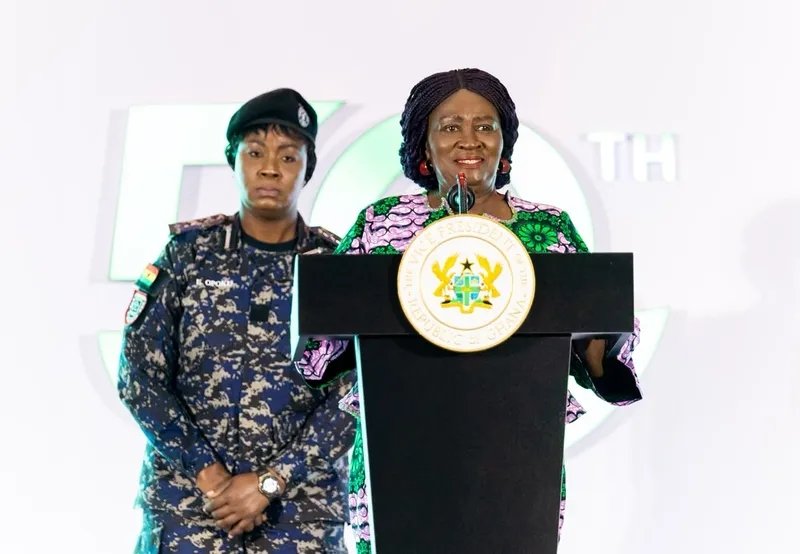
Vice-President Professor Naana Jane Opoku-Agyemang has urged the Bank of Ghana to assist rural banks struggling to meet revised capital requirements under the country’s new community banking framework.
She made the appeal as Ghana moves from rural banking to community banking, warning that some institutions face difficulties in complying with the new regulatory demands.
Speaking at the 24th Biennial General Meeting of the Association of Community Banks in Takoradi, held as part of events marking the 50th anniversary of rural banking in Ghana, the Vice-President said the transition offered both opportunities and challenges.
The revised microfinance sector framework, which converts rural banks into community banks, would allow the institutions to broaden their operations and serve customers in rural and urban communities, she said.
However, it also placed additional pressure on the banks, particularly through higher capital requirements.
“The space is not even, but I’m appealing to the Bank of Ghana to support those who have not reached where they should be,” she said.
Professor Opoku-Agyemang said helping weaker institutions would contribute to a stronger financial sector capable of serving all sections of society, especially people at the bottom of the economic pyramid.
She reaffirmed the government’s recognition of community banks’ contribution to Ghana’s economic development, including their financing of small businesses, agriculture and related activities.
Their local knowledge placed them in a strong position to support enterprises, she said, because they understood customers’ financial circumstances, seasonal income patterns and business operations.
Ghana’s rural banking system began with the establishment of the first rural bank at Agona Nyiaku, created to improve access to formal financial services in rural communities. At the time, banking facilities were concentrated mainly in urban areas, leaving farmers and small businesses with limited access to credit.
The Vice-President also recognised the contribution of Dr. Duffuor, whom she described as her uncle and the first chairman of the pioneering rural bank.
The sector has since grown from one institution to 147 banks nationwide. Citing the Bank of Ghana’s 2025 annual report, she said total assets had increased by 32 per cent, reflecting the growing importance of community banking in Ghana’s financial system.
Despite that progress, she said more communities and businesses needed to be brought into the formal financial sector.
She called on the Association of Community Banks, the Association of Rural Banks (ARB) and Apex Bank to help member institutions manage the regulatory changes and make use of opportunities within the new framework.
Directors and managers were also urged to maintain strong corporate governance, provide effective oversight and ensure lending decisions protected the long-term interests of their institutions.
Prudent lending, sound risk management and effective loan recovery were essential to preserving public confidence, she said.
On digital banking, Professor Opoku-Agyemang said the increased use of technology required greater investment in cybersecurity and staff training to protect customers from fraud.
“Community banks must offer customers convenience without exposing them to unnecessary risk,” she said.
She also encouraged closer cooperation between government institutions and community banks to improve access to suitable finance for businesses underserved by conventional lenders.
The Vice-President said the 50-year history of rural banking had created an important network of locally owned financial institutions. The conversion to community banks, she added, provided an opportunity to strengthen operations, improve services and increase their contribution to local economic development.
She expressed confidence that the meeting would help address the key decisions needed for a successful transition before declaring it officially open on behalf of President John Dramani Mahama.