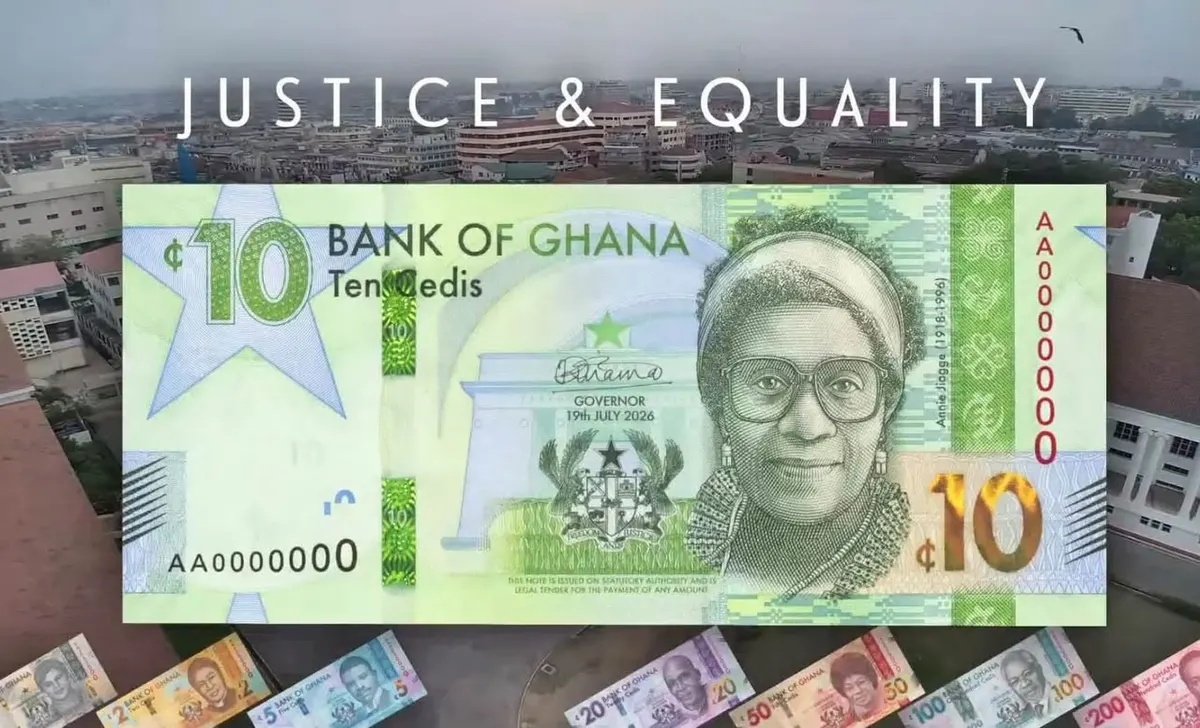
The new green GH¢10 banknote in Ghana’s Heritage Series features Justice Annie Ruth Jiagge, the judge whose work with the United Nations helped produce the first international declaration addressing discrimination against women.
The Bank of Ghana unveiled the Heritage Series at its head office, Bank Square, in Accra, on Thursday, November 12. The redesigned notes will enter circulation from December 1, although the existing banknote series will continue to be legal tender.
At the launch, Governor Dr Johnson Pandit Asiama said the designs brought together notable Ghanaians, important sites, monuments and Adinkra symbols. The aim, he said, was to connect people with the country’s history through the money they use each day.
Jiagge’s portrait appears on the GH¢10 under the theme “Justice and Equality”. The reverse shows the Supreme Court building, with the monument to the Martyrs of the Rule of Law in front of it. Epa, the Adinkra symbol associated with law and justice and shaped like handcuffs, is also featured.
A pioneering legal career
Jiagge studied law in London at the London School of Economics and Lincoln’s Inn. After returning to the Gold Coast in 1950 as a qualified lawyer, she worked as a barrister before becoming a magistrate.
President Kwame Nkrumah appointed her to the High Court in 1961. She was among the first women in the Commonwealth to hold such a judicial position.
The following year, she was selected to serve on the UN Commission on the Status of Women, having already established herself as a leading figure at the Ghana bar.
She became the commission’s rapporteur in 1966 and was elected president in 1968. The United Nations’ list of chairpersons records her as president of its 21st session that year.
Her most significant contribution came in 1967, when she drafted the text later adopted by the UN General Assembly as its declaration on ending discrimination against women.
That declaration provided the foundation for the 1979 Convention on the Elimination of All Forms of Discrimination against Women, commonly known as CEDAW. The UN describes the convention as the main international instrument defining women’s rights.
In 1993, the UN Secretary-General personally invited Jiagge to join the advisory group responsible for planning the Fourth World Conference on Women in Beijing. A UN tribute to her was read at her memorial on August 3, 1996.
Her portrait is one of eight introduced on Ghana’s new banknotes, ranging from Kwame Nkrumah on the GH¢200 to a market trader on the GH¢1.
The decisions over who was included have prompted debate. Kwame Nkrumah remains represented, while the Big Six were not included collectively.
The Minority is seeking to have the Bank of Ghana Governor summoned before Parliament to answer questions about the new notes.