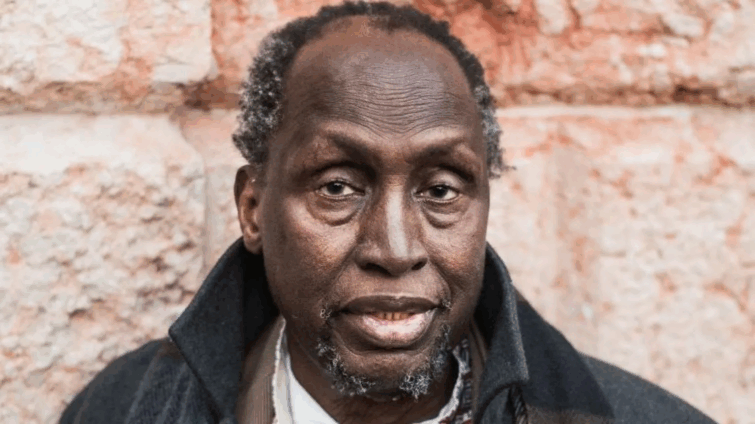
Ngũgĩ wa Thiong’o, who has died aged 87, was a titan of modern African literature – a storyteller who refused to be bound by jail, exile and illness.
His work spanned roughly six decades, primarily documenting the transformation of his country – Kenya – from a colonial subject to a democracy.
Ngũgĩ was tipped to win the Nobel Prize for Literature countless times, leaving fans dismayed each time the medal slipped through his fingers.
He will be remembered not only as a Nobel-worthy writer, but also as a fierce proponent of literature written in native African languages.
Ngũgĩ was born James Thiong’o Ngũgĩ in 1938, when Kenya was under British colonial rule. He grew up in the town of Limuru among a large family of low-income agricultural workers.
His parents scrimped and saved to pay for his tuition at Alliance, a boarding school run by British missionaries.
In an interview, Ngũgĩ recalled returning home from Alliance at the end of term to find his entire village had been razed by the colonial authorities.
His family members were among the hundreds and thousands forced to live in detention camps during a crackdown on the Mau Mau, a movement of independence fighters.
The Mau Mau uprising, which lasted from 1952 to 1960, touched Ngũgĩ’s life in numerous, devastating ways.
In one of the most crushing, Ngũgĩ’s brother, Gitogo, was fatally shot in the back for refusing to comply with a British soldier’s command.
Gitogo had not heard the command because he was deaf.
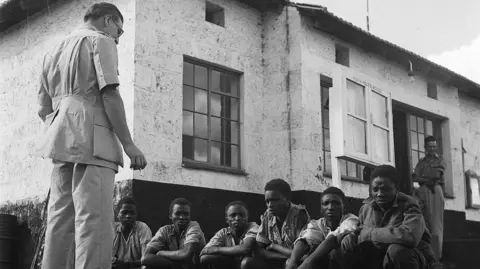
In 1959, as the British struggled to maintain their grip on Kenya, Ngũgĩ left to study in Uganda. He enrolled at Makerere University, which remains one of Africa’s most prestigious universities.
During a writer’s conference at Makerere, Ngũgĩ shared the manuscript for his debut novel with revered Nigerian author Chinua Achebe.
Achebe forwarded the manuscript to his publisher in the UK, and the book, named Weep Not, Child, was released to critical acclaim in 1964. It was the first major English-language novel to be written by an East African.
Ngũgĩ swiftly followed up with two more popular novels, A Grain of Wheat and The River Between. In 1972, the UK’s Times newspaper said Ngũgĩ, then aged 33, was “accepted as one of Africa’s outstanding contemporary writers”.
Then came 1977 – a period that marked a huge change in Ngũgĩ’s life and career. For starters, this was the year he became Ngũgĩ wa Thiong’o and shed his birth name, James. Ngũgĩ made the change as he wanted a name free of colonial influence.
He also dropped English as the primary language for his literature and vowed to only write in his mother tongue, Kikuyu.
He published his last English language novel, Petals of Blood, in 1977.
Ngũgĩ’s previous books had been critical of the colonial state, but Petals of Blood attacked the new leaders of independent Kenya, portraying them as an elite class who had betrayed ordinary Kenyans.
Ngũgĩ didn’t stop there. The same year, he co-wrote the play Ngaahika Ndeenda (I Will Marry When I Want), which was a searing look at Kenya’s class struggle.
Its theatre run was shut down by the government of then-President Jomo Kenyatta, and Ngũgĩ was locked up in a maximum security jail for a year without trial.
It was a fruitful 12 months, however, as Ngũgĩ wrote his first Kikuyu novel, Devil on the Cross, while in prison. It is said he used toilet paper to write the entire book, as he did not have access to a notebook.
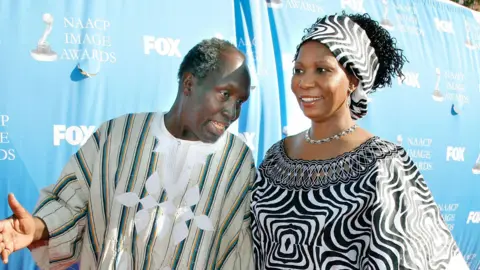
Ngũgĩ was released after Daniel arap Moi replaced Mr Kenyatta as president.
Ngũgĩ said that four years later, while in London for a book launch, he learnt there was a plot to kill him on his return to Kenya.
Ngũgĩ began self-imposed exile in the UK and then the US. He did not return to Kenya for 22 years.
When he finally did return, he received a hero’s welcome – thousands of Kenyans turned out to greet him.
But the homecoming was marred when assailants broke into Ngũgĩ’s apartment, brutally attacking the author and raping his wife.
Ngũgĩ insisted the assault was “political”.
He returned to the US, where he had held professorships at universities including Yale, New York and California Irvine.
In academia and beyond, Ngũgĩ became known as one of the foremost advocates of literature written in African languages.
Throughout his career – and to this day – African literature was dominated by books written in English or French, official languages in most countries on the continent.
“What is the difference between a politician who says Africa cannot do without imperialism and the writer who says Africa cannot do without European languages?” Ngũgĩ asked in a seminal, fiery essay collection, named Decolonising the Mind.
In one section, Ngũgĩ called out Chinua Achebe – the author who helped to launch his career – for writing in English. Their friendship soured as a result.
Away from his literary career, Ngũgĩ was married – and divorced – twice. He had nine children, four of whom are published authors.
“My own family has become one of my literary rivals,” Ngũgĩ joked in a 2020 LA Times interview.
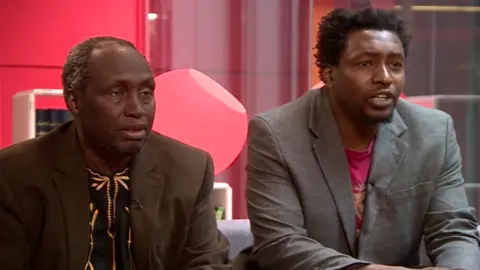
His son, Mukoma wa Ngũgĩ, has alleged that his mother was physically abused by Ngũgĩ wa Thiong’o.
“Some of my earliest memories are me going to visit her at my grandmother’s where she would seek refuge,” his son wrote in a social media post, which Ngũgĩ wa Thiong’o did not respond to.
Later in his life, Ngũgĩ’s health deteriorated. He had triple heart bypass surgery in 2019 and began to struggle with kidney failure. In 1995, he was diagnosed with prostate cancer and given three months to live.
Ngũgĩ recovered, however, adding cancer to the lengthy list of struggles he had overcome.
But now one of African literature’s guiding lights – as Nigerian writer Chimamanda Ngozi Adichie once called him – is gone, leaving the world of words a little darker.